Showing posts with label T.S. Eliot. Show all posts

Sunday, 9 August 2015

Tart Words


Mark Levine recalls his first experience reading "The Love Song of J. Alfred Prufrock."
The spirit of the poem is punky and irreverent, spot-on in its mockery of the starched language of authority and smeared with the grime of its churned-up dream life. I don’t know a thing about Eliot, but I know a teenage wasteland. This poem feels like home: Not the one I live in, but the one that lives in me.

‘‘Prufrock’’ would become the poem that lent my adolescent self protection from the wounds of chronic alienation and gave me tart words to wield against the insipidness of the world. Eliot himself was barely out of his teens when he wrote it, uncannily in touch with the exquisite torments of hypersensitive youth, and with the peculiar burden of seeing through everything without having experienced much of anything. This was a different species of verse. It exuded cinematic urgency rather than exam-ready ‘‘messages’’ and ‘‘themes.’’ It was full of sudden rhythmic jolts and colliding tones, and could make emotional pirouettes on a vowel. Unapologetic, brash, discontinuous, ‘‘Prufrock’’ taught me the thrill of disorientation in language. No matter how often I returned, it was never tamped down by classroom-style explanations. It grew. It seemed to understand me more than I understood it.

Friday, 5 June 2015

Illustrating Eliot

Julian Peters adapts Prufrock into comic-book form. You can check out the rest of the pages here.

Sunday, 17 February 2013

Faber Photos

There's some amazing stuff archived at Faber's flickr photostream. Here's a sample.


W.H. Auden.

Ezra Pound.

Robert Lowell.

T.S. Eliot's office door.

Seamus Heaney.

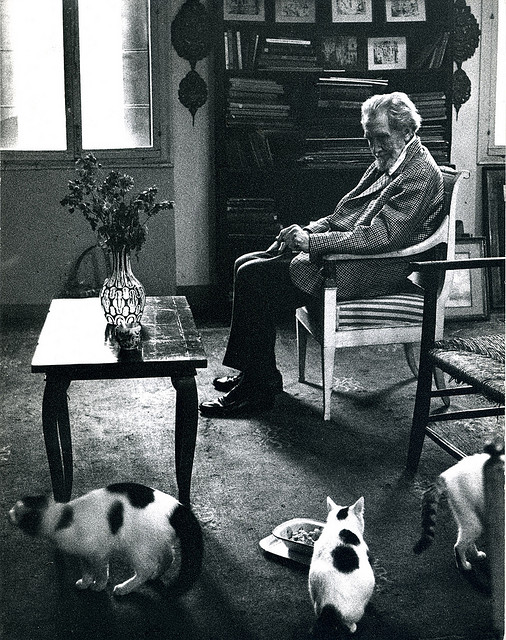
W.H. Auden. T.S. Eliot and wife Valerie.

Craig Raine and Ted Hughes.

Sylvia Plath feeding deer in Ontario (yes, Ontario).

Saturday, 30 June 2012

Heap of Broken Images


Tess Taylor spends some time with The Waste Land app, and comes away feeling meh:
"Though I came to like the app better as I settled into it, I was never wholly at home. I couldn’t figure out a way, exactly, to review it as an object or text except to have recourse to a description of my own ambivalence exploring it. Its notes are excellent, its productions learned, its films finely produced, but I still felt thornily lost in the thicket of my own encounter. Was this reading or wasn’t it? Is this production and distribution of simultanaeity a significant form of newness? Is this the future of reading or merely one possible future? Is this a mirror of our own distractedness or a tool that can make our reading more accessible?"