Showing posts with label Peter Richardson. Show all posts

Friday, 1 May 2015

Weather Front


Peter Richardson's writing day begins in the cellar:
Every morning before breakfast, I descend two half-flights of stairs to one of those venerable pine secretaries with a folding top which you sometimes see at auctions.

There, on a rickety cane-seated chair, I jot in a spiral notebook, using blue pencils with smudge-proof erasers. A stylus and clay tablet would do as well. I write on one side of a page because I like to return to old notebooks and cull through them. When I go back to them many months later, I want those tomes legible.

The desk is a hand-me-down. My mother used it as the platform for her letter-writing campaigns of the Fifties and Sixties. Often coming home from school, I would hear her Smith-Corona clacking away in the study off her bedroom. The fact that we lived on a decommissioned farmstead six miles from the nearest town may have nourished her need to write to The New York Times or Commonweal on issues of utmost importance. Yet I think if we had stayed in southern Connecticut rather than decamp to northern Vermont in 1960, she would still have found time to correspond with a grab-bag of different people.

Sitting at the same desk, I record thoughts about a book I’ve been reading, scraps of dreams, or observations of clouds, and by that, I mean, what weather front is sweeping towards me across the spine of Gatineau Park. Living on a ridge above the Alonzo Wright Bridge not far from Cantley, Quebec, I find we get our share of blustery hill country days. With snow whipping against two transom windows to my left, I suppose that I hope to find myself riffing on a subject I won’t know I’m writing about till I’m about three sentences into it.

Sunday, 24 August 2014

Sunday Poem


SONG OF THE CANISTER'S CONTENTS 
After we thinned out we joined clouds
darkening cleared land and then
we were the shadows of those clouds
crossing open heaths. 
Our green breath had to continue
till we were lingering
molecules causing mild headaches
among Flemish cattle. 
When parts of our advancing front
united with water,
we converted damp wagon tracks
to pickling vats. 
We had no wish other than to float
past tatters of swans
a half-mile above our objective
in the scored earth.
The one who housed us in metal
had a chemist wife
who shot herself with his pistol
upon our dispersal. 
If only a huge ventilator, poised
to buoy us skyward,
could have been deployed
by top-flight sappers. 
But wrists had to go awry as wind
stroked us northwest
through sandbagged parapets
into scorched lungs.

From Bit Parts for Fools (Goose Lane Editions, 2013) by Peter Richardson

“Song of the Canister’s Contents” contains a reference to Clara Haber (1870-1915) who shot herself not long after learning of her husband Fritz’s success at putting chlorine gas into cylinders and supervising its dispersal at the Second Battle of Ypres.

Sunday, 22 January 2012

Sunday Poem

STANDING BY

“
Suitcases do get misrouted,” I say
as he swabs my testicles with yellow
disinfectant, and one at a time,
separates the two halves of my
scrotum with forefinger and thumb,
wielding a local anesthetic, which
as I discuss the two automated
baggage sorting terminals, one
in Denver, the other in Hong Kong,
renders small talk possible. Surely
my hands don’t want to be parked
on my chest, assisting from afar?
They want to stray to where tubes
are being cut, ends cauterized,
future paternity nul-and-voided.
An electrical fire I don’t watch
seals my clipped gametal ducts
as I natter on about Hong Kong
at Dr. Carrier’s behest. Go on, yes,
about feeder belts and standby
baggage and how many million
tons of fill were shipped in to make
an island planes could land on,
while another part of me has to be
reminded to stay up at my chest.
I must be a recumbent figure
forged onto a medieval tomb,
a protective spirit overseeing
the desk of an obscure prelate.
“Your hands want to go lower,”
he says and we snigger at that,
at how much it sounds like a joke
about three farmer’s daughters
and a lucky travelling salesman—
halter tops flying in scenarios
we might get to the bottom of
in a bowling alley or duck blind.
Though already I can sit and hold
a wing-shaped band-aid in place.
I’m grateful for pinpoint accuracy,
for the proper use of materials
that lay close to hand, for cuts
so small there are no stitches
as I slide off the bed-table, dress
and begin a week of lollygagging
far from the site of my livelihood:
those festivals of Airbus-319’s,
wheeling up to painted stop-lines
where stevedores are standing by.
From An ABC of Belly Work (2003) by Peter Richardson

Saturday, 19 November 2011

2011 Montreal Prize Results

Congratulations to Susan Glickman (pictured above) and Peter Richardson for making the shortlist of the Montreal International Poetry Prize. The $50,000 winner, selected by Andrew Motion, will be announced next month.

(Photo by Nancy Shanoff)

Sunday, 14 August 2011

Sunday Poem


DIP

I dip down to your neck like one of those birds
poised over a drinking glass in a diner—
a small bobbing crane who demonstrates
temperature differences in a room

where waitresses rush around delivering
seafood platters to families
with noisy small children who suffer
the heat badly, and truckers,

who glance sideways and shrug
at this end-of-summer pageant. See
how easily I move away from your neck
which is the subject, not diners,

no seafood platters though these too
have their place. Any consideration
of your neck must have movement,
people bending down, babies

being tended. After hours, after
this diner has closed for the winter,
and its occupants have gone back to jobs,
troubled marriages, rent-controlled apartments,

I am the small bobbing crane who stays there,
fridge thermometer snug in its belly,
dipping downwards towards the coolness
of a half-filled glass of water.
From A Tinkers' Picnic (1999) by Peter Richardson.

Saturday, 2 July 2011

Saturday Poem


THE FIST-PUPPET'S SOLILOQUY

You have to look past my felt-tipped eyes,
my lolling tongue drawn by the granddad
or uncle who has talked too long at lunch
and knows he must entertain the toddlers
with his jabbering, magic-markered fist.

I am the last item on your list, the puppet
that costs nothing to make: the bogeyman
couched between worn index and thumb,
my snarl converted to a hayseed's guffaw.

Admit that I bear traces of inbreeding,
that my face and body must always be
an abomination to children of any age,
that it twists me up inside to hear them

clamour for more of my troll's antics.
If you like hearing cracker bromides,
say that I also favour arenas, imperial
banquets involving human sacrifice,
oblations to the god of spewing lava.

Demand for me rises as I'm washed off
another hand in another suburban sink.
Others are waiting in need of laughter.
It is time I dusted off my Punchinello
and swam out into a little sea of faces

with my disfigurement at stage center:
winded, bleary-eyed, yet discovering
after each pratfall, a dropper's-worth
of the bile which keeps me going.

Saturday, 11 July 2009

Visual Poetry

Last week, the Montreal Gazette launched a video series featuring readings by local poets.

In all, eighteen Montreal poets are scheduled to appear. They include Robyn Sarah, Peter Richardson, David Solway, Katia Grubisic and Norm Sibum.

The Gazette plans to post two videos a week, on Wednesdays and Fridays, throughout the summer.

Go here to see David McGimpsey read his poem "Montreal."

Wednesday, 11 February 2009

Palmu blogs Richardson

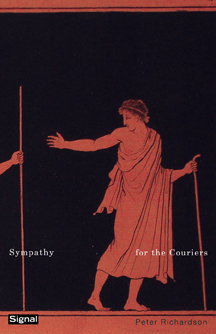
Brian Palmu posts a blow-by-blow review of Peter Richardson QWF prize-winning poetry collection, Sympathy for the Couriers.

“Peter Richardson is a major voice in contemporary Canadian poetry. It’s a delight to read, one after another, vivid and necessary poems about people, events, issues, idiosyncratic and various experiences"

Read the rest here.

Read an interview with Peter Richardson here.

Monday, 15 December 2008

Flash Interview #2: Peter Richardson

Peter Richardson’s first book of poetry, A Tinkers’ Picnic (1999) was shortlisted for the Gerald Lampert Award. His second book, An ABC of Belly Work (2003) was a finalist for the Acorn-Plantos Award.

Richardson's third book Sympathy for the Couriers (2008) recently won the QWF's A.M. Klein Prize for Poetry. For over 24 years, he was employed by Air Canada as a ramp worker. Retired, he now lives in Gatineau, Quebec with his wife and daughter.

The following interview was conducted by e-mail.


CS: Sympathy for the Couriers includes some of your most ambitious dramatic monologues. What is it about talking in other voices that you like? Do the voices visit you, or do you go looking for them?


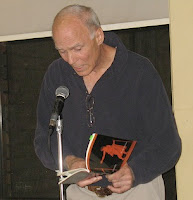
PR: I wouldn’t say I go looking for them, unless you can call fifteen or twenty minutes of free-writing before breakfast a way of sending out a psychic casting call. I either write from an emotion and get a line I like that is declamatory and evocative, or I start with something visual-an object or scene. For instance with the Professor Basso poem, I had the image of snow blowing by a monastery window. That’s it. There was a line that went with the image which later disappeared from the poem. But I had a visual clue. And then, much later, I had this man running and sliding down a ravine in blowing snow. With the monastery already in the picture, I began to see who this person could be through a series of longish lines, each asking to be about the same length. Line length is an important ingredient in developing a scenario. Or, at least, that has been my experience.

So I work with a personality which declares itself in a line and then opens up over further lines, or I’m given a picture. (I do like writing about objects too, which is another worthy trajectory to take, partly because objects can sometimes be connected with people we know.)


CS: Humour is a big part of your poetry. Do you think Canadian poems are too earnest?


PR: That’s a tricky question, because if a poem is well-written, it can be as earnest as it wants to be and it will get a lot of readers on board. Jason Heroux gets away with it in a recent poem of his called “Lost Forest” because he’s written a fine haunting poem. But I’ve noticed that when it comes to nature poems, there’s a “high-in-the-pulpit-hand-wringing” school of lyricists, who first have do a kind of public obeisance before nature before they can get on with their text. I find that irritating. Fortunately, there are plenty of writers who don’t fall into that trap. Patrick Warner is an example. Curiously, he is also an intelligently funny poet.


As for humour, if it’s innate and not pasted on, if it’s really a part of your sensibility, then I think it can tap into a wide emotional spectrum. There are so many kinds of humour, and I’m a fan of most of them. In our family, when I was growing up, wry, sarcastic and cynical humour were big favourites. My parents, of course, weren’t big on the cynicism but it sometimes drew my brothers and I to hilarious heights. How could we not be cynical when we saw Vietnam war coverage on the CBS which would segue into ads for Alpo dog food? Absurdist humour, on the other hand, was acceptable at the dinner table because as a family, we were big on writers like James Thurber and A.J. Liebling. And when I think of it, different types of humour do appear in plenty of my poems. They are a defence, I guess, against a prating, heavy-browed, Archbishop-Sheen-like approach to poetry which sends me in the other direction. But they are also a reflection of what I think is worth celebrating at some sub-basement level of my personality. That said, though, I believe in the elegy and in plenty of other kinds of serious poetry.

CS: How would you describe the contemporary Canadian poetry scene to one of the baggage handlers you used to work with?


PR: Could I get them to sit still long enough to talk for even a minute on that subject? But here I’m short-changing an extremely varied and surprisingly smart group of people from whom I was able to learn a lot and for years. I guess I would do a thirty-second sound bite. I’d say: “The Canadian poetry scene is a bunch of rabid dogs who mean well and get along well within their own tainted kennels. And in their favour, they represent about every type of poetry being written. Sometimes they make magnanimous gestures amongst themselves and reach across aesthetic lines to celebrate others who do not necessarily buy their way of seeing a lyric. But they’re still in the process of building something remarkable. They’re not there yet, which explains why you guys don’t browse in the poetry section of Chapters. You might be missing a few revelatory gems, but generally, I can’t fault you for sticking to thrillers.”


CS: Can you come up with one thing about the writing life that drives you batty?


PR: Nothing that wouldn’t sound like I was carping and I’m in a good mood today.