Showing posts with label Robyn Sarah. Show all posts

Saturday, 5 December 2015

Metaphor in the Moment


Robyn Sarah explains how poetry gives form to insignificant moments or details:
People often say my poems trigger memories of things they had long forgotten, but that isn’t what I think of myself as doing when I write. I do recognize that as a poet, I’m (among other things) a documenter of detail and a documenter of moments, whether I’m writing about the present or the past remembered—but the mere giving form to “what might otherwise be lost or forgotten”, no matter how beautifully one records or describes it, is not enough to make a poem. The real question is why do these “seemingly insignificant” moments or details from the past come back to us? Or, if we are talking about present time, why do we notice the particular little things we do? I believe the details that catch our attention, or the moments that come back to us unbidden and insistently, do so because they are not insignificant. They have a metaphoric weight for us. They signify, in a language that the unconscious knows, though the conscious mind may not. What haunts us is not the moment but the metaphor in the moment.

Sunday, 19 April 2015

Sunday Poem


TOO LATE  
The power was out when we went to bed
that night, remember? It had been out
since suppertime—one of those late
afternoon thunderstorms
that used to roll through the valley
like a tidal wave. We blew out the candles,
forgetting which lights had been on,
forgetting about the radio
till, soon after we’d drifted off,
it jumped to life, full volume,
(along with the bedside lamp)
for a brutal second—just long enough
to jolt us awake with a dire,
frenetic male voice proclaiming, “Too late!”
For an instant we blinked at each other,
stupefied. You lunged for the radio knob
as the room went black again,
and there we lay, in country dark
(so much darker than city dark)
with that voice still echoing in our heads.
Was it too late? For what?
There were numerous possibilities.
Even back then, there were numerous
possibilities. The kids slept on, oblivious,
in their little rooms, their wooden bunks
under the flyspecked windows,
and after a moment we began to laugh,
a laugh we can reignite
with those words to this day.
Too late!
We dissolved in each other’s arms
in helpless laughter.
From My Shoes Are Killing Me (Biblioasis, 2015) by Robyn Sarah

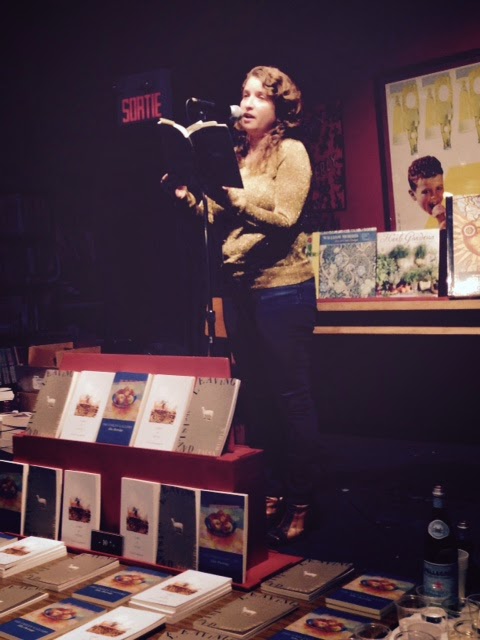
Signal Editions, Montreal Gala Launch, April 16, 2015


Chad Campbell, reading from Laws & Locks.
Talya Rubin, reading from Leaving the Island.

(From left) Ewa Zebrowski, Marsha Courneya, Carmine Starnino, Chad Campbell, Nancy Marelli


Carmine Starnino, Talya Rubin, Robyn Sarah

Thursday, 19 February 2015

Jump-starting a Poem


Robyn Sarah believes that collage—the assemblage of diverse elements or fragments—is at the root of most poetry:
Poetic logic is nonlinear; it makes leaps; on some level it is improvisational, free-associative. One of the things a poet does intuitively is to discover/uncover unlikely connections between diverse particulars by placing them next to each other (e.g. last night’s dream; today’s weather; something heard on the news). Whether these particulars come out of one’s daily life, out of one’s head, or out of somebody else’s written text, the poet is doing the same thing: choosing, highlighting, and juxtaposing things that have caught attention. It also doesn’t matter whether they are freshly observed or remembered/rediscovered. I keep notebooks where I jot things down as they come to me—physical or sensory particulars, random thoughts, words or phrases, words heard or read, stray memories. Why did they catch my attention on the day I noted them—who knows? Some jottings begin growing immediately into poems-in-progress; others just sit there, waiting to catch my attention again. They ripen as I get older. They accrue. After four decades of keeping notebooks, there’s a wealth of such material to draw on for inspiration on a day when I need a jump-start.

Saturday, 25 October 2014

McKaybetes, Ctd


Here's a fascinating Facebook exchange sparked by Michael Lista's review of Don McKay's Angular Unconformity.

Brian Bartlett: Zach, As you no doubt suspect, I'm guessing that 100 years from now—if there is still a human race, & poetry--as many Don McKay poems will still be read & valued as poems by any other living Canadian poet. Speaking for myself, I can say that a few poems of his inhabit my consciousness as only the most memorable poems do. Some of the grousing about his "popularity" caricatures & belittles his readers as if none of them can separate the poet from the person. Also, Lista writes as if in ignorance that the (inevitable) counter-revolution against McKay has been going on now for more than a decade, including in the prose of some of our most articulate critics.

Zach Wells: Brian, I certainly do suspect that you and others hold such views. I also know that predicting future canonicity is a rather haphazard business and ever has been. Jarrell did it for Bishop, and it seems likely that he'll be proven correct, but far more people have said the poems of X, Y or Z will endure only to be proven fools by posterity. Look at any old Untermeyer antho. And just because it happens doesn't mean it's merited. Bliss Carman, who was a truly mediocre poet, still has work in print that is taught in Canadian Literature classes. The competition was a trifle weaker in his day, however. The sheer volume of McKay fans and acolytes will ensure that his work persists until at least they're gone. After that, it's anybody's guess. But what is most popular in any given time and place very rarely overlaps with what is most durable.

Here's the thing about popularity as a topic for critical consideration. Talking about masses and statistics does not actually belittle or caricature any individual reader. I have no doubt that there are individual readers who successfully separate the personality from the poems (or are blissfully ignorant of the personality) and have an unclouded appreciation of McKay's poems. What I'm saying is that the number and distribution of such people is not sufficient to make a McKay the revered figure that he is. Peter Van Toorn has such readers. Bruce Taylor has such readers. Robyn Sarah has such readers. Peter Trower. Travis Lane. But they don't have the pyramid of lesser readers below them that a McKay does. That mass of less-detached readers is what makes the difference between neglect and celebrity. It's the difference between having a 600+ page hardcover Collected selling like hotcakes while you're still alive and having your books go out of print.

The music study and the wine studies cited by Mlodinow are illustrative of very real sociological phenomena. They're phenomena that have benefited McKay enormously. It isn't insulting to his most ardent fans to point this out. And it's naive to think that you're immune to such influences, especially when you know the guy, which is not a factor in wine tasting errors or in preference for one song over another by bands you don't know. It's a major cognitive bias and the principle reason I avoid writing essays about friends' work.

Lista makes brief mention of the "minority reports" by people like myself, Shane Neilson, Carmine Starnino, Don Coles and Richard Greene. He doesn't ignore them, but he doesn't have space in a column to digress at any length on them. So it's inaccurate to say he writes "as if in ignorance." And I, personally, do not feel slighted because he didn't mention my 7,000 word skeptical take on the McKavian oeuvre. Richard clearly isn't miffed that his review of Apparatus wasn't mentioned explicitly. Michael's not trying to steal our thunder; he's adding his voice to a very slowly growing chorus of dissent.

Brian Bartlett: Zach, I've read a bit of literary history, & know very well the risks of "predicting future canonicity." (Yet I indulge in fantasies, such as that a century from now Ashbery's reputation will be greatly diminished.) One reason reading Dr. Johnson's Lives of the English Poets is so fascinating--many of the poets he writes about now largely forgotten & unread (not that he was predicting their future readership). Still, it's a familiar human propensity to look a century ahead--maybe it's wishful thinking on my part to imagine that McKay will have future readers (after the current crop of his enthusiastic readers are "gone," as you put it).

As for being "naive," notice that "belittles his readers as if none of them..." is in 3rd person--at this point I won't be foolish enough to claim I can make a clean separation between person and poet, just as I can't with Don Coles, Bruce Taylor, Robyn Sarah, Travis Lane, Harry Thurston etc., though unlike you I'm sometimes okay writing about poetry by friends—maybe because my approach is generally more exploratory & investigative than evaluative. (Let's not get into an discussion about how all criticism is evaluative, implicitly or otherwise, okay?)

So McKay's book is "selling like hotcakes"? Goose Lane might be interested to know. It amuses me when people talk as if widely praised poets are household names. Are we talking about J. K. Rowling or John Grisham? Are we even talking about Atwood or Munro? While that dizzily poet-idolizing note you shared with us is, yes, embarrassing, a word like "cult" goes beyond hyperbole to stupidity. Even "celebrityhood" is rather funny when it comes to the relatively tiny readership that even much-appreciated poets get.

One thing we agree upon is that wonderful poets (we've both championed Van Toorn and Taylor, for instance) deserve many more readers. I agree that some of McKay's relative "popularity" could be fairly shared by other excellent poets—but he's not responsible for the fact that plenty of people like his work, & it's unfair to use the neglect of those other poets as a stick to beat him over the head with. As for the "very slowly growing body of dissent," it seems to me that among Canadian male poet-critics ("some of our most articulate critics," I referred to them in the previous message) with books or the equivalent of criticism published, attempts to concentrate on McKay's weaknesses & complaints about his readership have become de rigeur. Really nothing new in Lista's approach.

Are You at Risk of McKaybetes?


"In rooting (in both senses) for the often empty calories of [Don] McKay’s words," writes Michael Lista, "our waistlines lengthening and blood sugar spiking, too many of us have succumbed to our national disease: McKaybetes." On the occasion of McKay's collected poems, Angular Unconformity, Lista tries to unpick the mystery behind that debilitating condition:
The question is: why McKay? Why did he, and not the half-dozen or so other top poets of his generation (who I suppose are now post-eminent), become the institution? There are a couple of reasons. By the time Birding, or desire appeared in 1983, McKay, with his ear for vernacular and rural affectations, looked like a natural inheritor of Purdy’s laureateship — itself rather dubious, looking back. His ecological high-mindedness was glossed with just enough aesthetic disaffection to make him seem cool, an attribute, real or imagined, about which Canadian poets are hysterically self-conscious. And the drive of his poems, all torque and no traction, dovetailed nicely with the emerging poetics of trying to get nowhere as quickly as possible (which itself is a cliché: “It’s less about the destination than the journey”).
Of course, there are Canadian poets who, bang for buck, are much better for your intellectual health:
It has to be said: If you put McKay cheek-to-jowl with other top, but less socially influential, practitioners of his generation, his work pales. Let’s meet him on his home turf, nature writing. Here he is on flora: “Flowers begin inhaling through their roots / exhaling darkness.” Again, McKay goes in for the sonorous vagary. Here’s the ex-pat Eric Ormsby on another flora, lichens: “Far-off they’re starlike, spiky as galaxies./ Like us they clutch and grip their chilly homes/ And the wind defines their possibilities.” Not only is he more magisterial by being precise, Ormsby less anthropomorphizes the lichens as he floralizes us, and in doing so sees the natural world in the human X-ray. Here’s the exquisite Robyn Sarah on a desiccated bouquet: “Brittle, dry and brown, / it seemed to speak too plainly of a waste / of friendship, forced to flower, culled in haste.”
Zach Wells dips his toe into the debate:
Michael Lista, in one of his strongest columns to-date for the National Post, has weighed in on Don McKay's doorstopper Collected Poems. He gets it mostly right, I think, but when he says that McKay has "spent a lifetime avoiding seeing the human in the natural world," he has done little more than repeat the press kit. As I argued in my long review essay of McKay's oeuvre-in-progress seven years ago (an updated version of which can be read in my recently published prose collection), this isn't really what happens in McKay poems. Rather, I'd rephrase Lista's statement thus: "Don McKay has spent a lifetime pretending to avoid seeing the human in the natural world." In actual fact, he does it all the time, especially if you compare him with that pre-eminent observer of the non-human world, John Clare--a birdwatching poet who comes up remarkably infrequently in prose by and about McKay. What appears to be a disjunction between McKay's poetics and his poems is actually evidence that McKay's poems tend to be more versified poetics than poems in their own right. Which is another reason, I think, he has been well-received by academic readers: not only do his poems tell you what you should be observing, as Lista points out, they also tell you what you should be thinking while you observe, and they tell you what you should be thinking about the poems themselves. They are therefore very easy to write about and to package in an interpretive argument.

Tuesday, 2 April 2013

Infinite Feedback Loop


Lazy Bastardism
was reviewed alongside new books by Glyn Maxwell and Mary Ruefle in the April issue of Poetry magazine. The conversation—held between Michael Lista, Ange Mlinko and Gwyneth Lewis—is utterly satisfying (and at times, for me, blush-inducing). One of the most interesting exchanges occurred over a few lines by Robyn Sarah that Mlinko first encountered in my book. Disappointed that Maxwell doesn't spend more time on the nuts-and-bolts of how metaphors are put together, Mlinko brings up Sarah:
To take as an example the lines I quoted from Robyn Sarah, was 
I really drawn to them because of the versification? 
at the back of the palate
the ghost of a rose
in the core of the carrot. 
Well, I admit, the anapest-ish bounce of those lines has something to do with their memorability, and the palate/carrot rhyme is indispensable, but the real achievement here is the oxymoronic yoking of the rose and the carrot (smell vs. taste; sweet vs. bitter; pretty vs. nutritive; pink vs. orange). Oxymoronic, but surprisingly true — 
I taste that rose now in raw carrots, indelibly. I think Maxwell would wager that the lightning-strike freshness of metaphor arose organically (no pun intended) from the modulation of the vowels and the fatedness of the rhyme. And there is a lot of truth to the idea that versification is a poetic machinery by which you find yourself saying smarter things than you would have otherwise (to paraphrase James Merrill). But I could just as easily posit that Sarah was actually cutting the top off a carrot, saw the radial symmetry of its core, glimpsed (at a lightning stroke) the visual rhyme with a rose, and constructed the musical lines to be the best container for this metaphor.
Michael Lista's reply:
I do think we’re drawn to the Sarah lines in large part because of the versification — it’s itself metaphoric. Yes, the “anapest-ish” bounce is part of it, but so too is the circularity and symmetry of (to use words Maxwell dislikes) the assonance and consonance (at, back, palate/ghost, rose/core, carrot) and that lovely slant rhyme of “palate” and “carrot.” The total effect is to give the aural, synesthetic impression of  both the cross-cut carrot and the spiraled petals of a rose. The metaphor is itself contained within a mnemonic metaphor, which makes forgetting the lines next to impossible. Today both bad free verse and bad formalism disappoint for the same reason: the form has been divorced from its metaphor. In the case of bad free verse, the form feels arbitrarily default, like a font. With bad formalism, it feels willfully decorative, like a font. When poems of each kind succeed, it’s because their containers — poetry
 is the only art form that is its own container — are constructed out of the materials of their contents, in a kind of infinite feedback loop.

Thursday, 6 December 2012

Dark Horse


I've put together a small selection of Canadian poets for the Autumn/Winter 2012 number of the excellent Scottish-American literary magazine The Dark Horse. I first heard of The Dark Horse in 1999 when, during a fellowship at the Hawthornden Castle, I paid Stewart Conn an afternoon visit at his home in Edinburgh. Just as I was about to leave, Stewart pressed a copy of the journal into my hands, and encouraged me to send them poems. I never did, but I finally meet the editor, Gerry Cambridge, at the West Chester Poetry Conference in 2010. I was there with Robyn Sarah, Bruce Taylor and Molly Peacock for a panel on Canadian poetry.  At one point during the conference, Gerry began distributing recent issues of the magazine, which, in the intervening years, had clearly taken a quantum leap in terms of design and direction. We struck up a series of conversations which continued into an email correspondance (I soon became a subscriber). I know Gerry would love to see more submissions—and subscribers!—from this side of the pond. A long review of Todd Swift and Evan Jones' anthology Modern Canadian Poets appeared in issue 26.

Sunday, 9 January 2011

Canadian Poetry Rebooted

It's finally here. Very happy to announce the Montreal launch of the controversial new anthology, Modern Canadian Poets, edited by Evan Jones and Todd Swift.

The evening will include readings by Evan Jones, Norm Sibum, Robyn Sarah, Anne Compton, Mary Dalton and David McGimpsey.

As anthologies go, this one is a big deal -- the first international one devoted to Canadian poetry in a half a century. Drop by and see what all the fuss is about.

Thursday January 13th 2011 from 7pm
Librairie Drawn & Quarterly
211 Bernard Ouest

Thursday, 24 December 2009

What I liked in 2009


Friends have been busting my chops to make public my favourite Canadian poetry of 2009. Since I've always had a weakness for bad advice, I’ve gone ahead and nailed my colours to the mast (if you're impatient, skip down the end).

To be frank, this sort of best-of exercise always leaves me in some distress because I have to overlook the books I feel strongest about, namely the titles I shepherd into print for Vehicule press. In 2009, those would be: Pure Product by Jason Guriel, Animals of My Own Kind by Harry Thurston and Boxing the Compass by Richard Greene. Each of these poets, while plainly unpigeonholeable, exemplify in their practice the values I’ve been trying to “brand” at Signal Editions: poetry that has a premium on intellectual idiosyncrasy, is technically mettlesome, brandishes an exacting sense of diction (but also allows for moments when that diction takes leave of its senses), and is bullshit-free.

So those three books, heartbreakingly, aren't on my list. Also missing are a couple of formidable collections whose only sin is that I guest-edited them: Figuring Ground by Robert Moore (Wolsak & Wynne) and Trace and Track by Zach Wells (Biblioasis).

So what's left? A list rich in authentic, affecting, well-rounded, unposturing poetry. What drew me to these ten books, however, wasn't their Goldilocks proportionality (not too hot, not too cold, just right) but that they were working at full poetic boil. They were also -- except, of course, for Rogers -- arresting advances on the respective poet’s prior books (especially Klassen who emerged as a far more exciting poet than I remember). In fact, I feel like our entire poetry scene has, over the last decade, teleported itself into a new level of ambition, with poets now sniffing out property values at the top of Parnassus (a topic I touched on here). We are becoming what Charles Simic -- in his essay “The Trouble with Poetry” -- called “a carnival of styles,” or poetry “that has the feel of cable televison with more than three hundred channels.”

Enough palavering. Here are the ten books I think 2009 might be remembered by.

Jane Again (Biblioasis), Wayne Clifford
Lean-to (Gaspereau), Tonja Gunvaldsen Klassen
Meniscus (Bibloasis), Shane Neilson
True Concessions (Goose Lane), Craig Poile
Paper Radio (ECW), Damian Rogers
Pause for Breath (Biblioasis), Robyn Sarah
Pigeon (Anansi), Karen Solie
Seaway: New and Selected Poems (Salmon Publishing), Todd Swift
The Hayflick Limit (Coach House), Matthew Tierney
Mole (Anansi), Patrick Warner

Honourable mention: Oneiric (Frog Hollow Press), Nyla Matuk

Saturday, 11 July 2009

Visual Poetry

Last week, the Montreal Gazette launched a video series featuring readings by local poets.

In all, eighteen Montreal poets are scheduled to appear. They include Robyn Sarah, Peter Richardson, David Solway, Katia Grubisic and Norm Sibum.

The Gazette plans to post two videos a week, on Wednesdays and Fridays, throughout the summer.

Go here to see David McGimpsey read his poem "Montreal."

Sunday, 15 February 2009

The Vehicule Channel

Straight from Simon Dardick's camera, here are three YouTube clips of the January 28th panel discussion at The Word.