George Ellenbogen
’s books include
Along the Road from Eden (1989) and
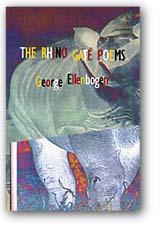
The Rhino Gate Poems (1996), which has been translated into German and French. He has read on both sides of the Atlantic and is the subject of a documentary film,
George Ellenbogen: Canadian Poet in America. A Montrealer by birth and upbringing, he lives in Boston.
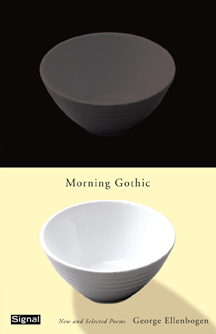
Morning Gothic: New and Selected Poems (2007) is his most recent book.
The following conversation between George Ellenbogen and Australian poet and critic
John Kinsella was conducted by e-mail.
Kinsella's questions are snippets from a much longer series of queries that can be found here.John Kinsella: You travel a great deal. This has obviously influenced subject matter in your poetry, but how do you think it has influenced the way your write poems?
George Ellenbogen: Travel is often a way of lighting the lamp rather then providing raw material for my work, though sometimes as in a recent trip to the Galapagos, it does that. But just as often, being in one place makes me aware of a place I have left and raises to the surface something carefully folded in storage. Years ago in the Arctic I found myself writing about south sea islands. Figure that!

But when I look at a poem like "Going by Rail," I realize there is something about the nature of movement, in this case a train, that has significance in the process of writing/conceiving. I've had an affection for trains that goes back to my earliest book published in 1957. When I peer out the window, I feel as though I'm having a cinematic experience, with the odd sensations that the individual shots that whiz by the window frame are disconnected strips of film...and of course they are...until one seizes my imagination and makes me a part of its narrative.
The visual sensations that come through the train's window are images. Most simply vanish like unfertilized eggs. The others, fertilized by whatever -- memory, imagination -- can either stand by themselves (as they do the imagist poems of Pound, HD, and numerous others in the early 20th c) or grow into other shapes, narratives for example. I expect this process works for a lot of sedentary poets as well, poets who are able to travel without either moving their feet or taking trains. But for me, the motion of travel accelerates the process.
JK: Would you say the visual is an important component of your poetry?
GE: In a general way the visual confirms my own bias -- that image is essential to poetry, echoing what Herbert Read said a long time ago about poetry being only as strong as its image (or was it metaphor? Doesn't matter, it works for both). Oddly enough, I am not a natural image maker; I have to work hard at it. My normal disposition is to be carried away by sound-tradition of Marlowe to Dylan Thomas -- which I find I have to guard against because when it surfaces it does so at the expense of image.
 JK:
JK: Your fourth book, The Rhino Gate, seems to me your major work (
excerpt here). What was the inspiration behind it?
GE: Normally when I'm in a writing groove, working on several pieces at the same time, new poems will come, usually in chunks of a few lines, which I then build on bit by bit. Once I have a half dozen lines or so, I have an idea of what the poem is about and what it will look like in terms of form. The composition of "The Rhino Gate" didn't follow this pattern. I started it in the summer of 1985 when I was in residence at the Karolyi Foundation in Vence, France. Sitting on the stone veranda in the back of my cottage, overlooking a densely wooded valley which separates Vence from the more celebrated St. Paul de Vence, the words "rhino gate" came to me. The phrase, as you can imagine, was totally enigmatic. But it was also haunting. Over the next few weeks, I added lines, with only a glimmer of where the poem was going, anticipating the sort of thing I usually turn out, a lyric between 25 and 60 lines. One day I scrambled down the valley, up the other side and walked onto the grounds of the Maeght Foundation, a splendid collection of 20th century paintings and sculpture, St. Paul de Vence's jewel. I was immediately struck by a Miro sculpture which has rhino features and, viewed sideways, can be seen as a gate, something that separates us from them (in the poem us becomes colonizers, security, order, rationality; them, the colonized, restiveness/rebellion, emotion). Clearly, what I saw around me was not going to let me give up on this piece. The writing and editing went on for five years. Incidentally, it was only when I was well into the poem, after a couple of years or so, that I realized that the narrator was a woman, the aging wife of an East African planter. I can't think of any other poem that I've written that has a female speaker. I often remark when I give a reading that God on a Monday morning was handing poems out to a queue of poets, that the woman ahead of me left the line for a tuna fish sandwich, and that I got her poem.
JK: What are you working on now?
 GE:
GE: I'm currently working on a memoir of my old Montreal neighborhood. It shifts between confessions of the neighborhood and autobiography, covering the period from earliest memories to when I went off to university in 1951. I remember that in addition to composition, history and geography were the subjects that appealed most because they removed me from the grimness of my elementary school and introduced me to a world outside my neighborhood ghetto (I believe 99% of the neighbors on my block were Jewish immigrants from Eastern Europe.) They were my exoticism in an unexotic world. My leftist history teacher in my first year at Baron Byng High School got me to see history in other than exotic lights. But along with appreciating the complexities that she introduced, I remained -- still remain -- attracted by the remoteness of earlier periods and off-shore places.
 Brian Palmu, who is quietly emerging as one of the sharper poetry critics in the Canadian blogosphere (admittedly, not a big group to begin with), gives us his notes to the 83 books of poetry he read in 2008 -- that's probably 82 more than any sane, well-adjusted man should have to read.