Showing posts with label Mary Dalton. Show all posts

Friday, 2 October 2015

Atlantic Cannibalism


Mary Dalton celebrates Frank Barry's flesh-eating play, Wreckhouse, first performed in St. John's in 2002:
Bringing to bear on his creation a wide-ranging knowledge of modernist and contemporary European drama, Barry draws on Brecht and Beckett, among others, in creating a surreal world, a postindustrial wasteland inhabited by a small band of cannibals who survive by trapping stray tourists, dancing them through mockeries of the usual tourist rituals, and cooking them up at a "folk feastival." The premise is grim indeed, but the analysis is astute, and the language play is stunning. In addition to its other strengths, Wreckhouse captures the fizz and spit, the ragged energy, of Newfoundland speech. With Early Newfoundland Errors, a later radio play by Ed Riche,Wreckhouse casts a cold eye on the way we live now. It is at once a dazzlingly funny play, and one of the darkest works in the literature, as bitter a piece of social commentary as Swift's "A Modest Proposal" and Christopher Bond's play Sweeney Todd, The Demon Barber of Fleet Street.
(Illustration by Alberto Elia Violante)

Wednesday, 29 April 2015

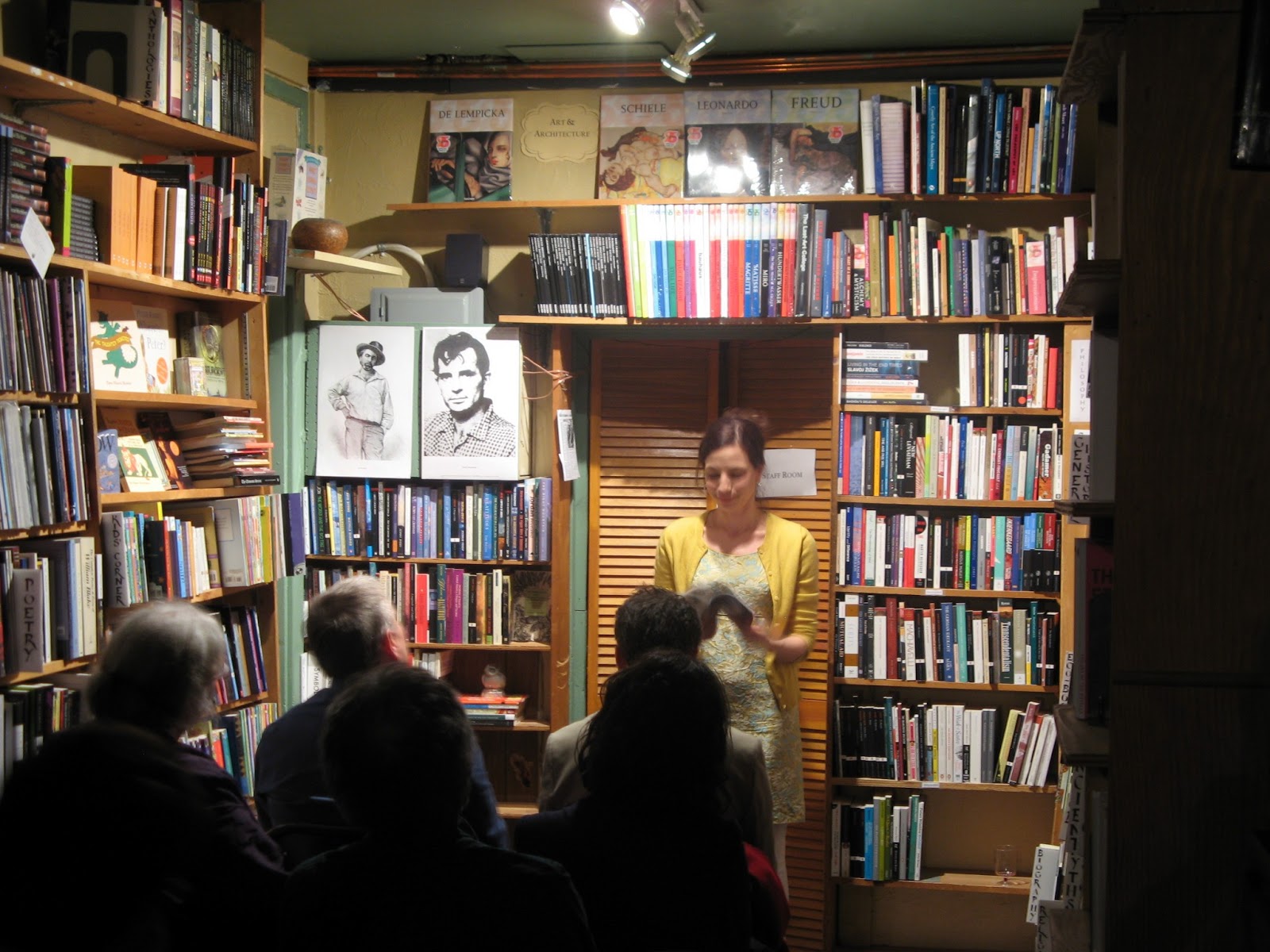
Mary Dalton at Harvard


Wednesday, 4 March 2015

Hear It Sing


Kevin McNeilly reports on Stephen Burt's recent lecture at UBC called “The Use of Poetry and the Use of Place.”
He concentrated on the work of two key poets, for him: C. D. Wright and Mary Dalton. Quoting from Wright’s “Ozark Odes”—“Maybe you have to be from here to hear it sing”—Burt developed the homonymy of here and hear to suggest that Wright’s poems generate the textures and particularities of place apophastically, allowing the reader access through lyric attention, through the melopoeic richness of her geographically precise diction, to a phenomenologically rich encounter with that particularity. You hear the place, you sense it, palpably, in Wright’s words, despite and even because of her skeptical refusal to claim communicative success. The withdrawing “melt” of her language, in other words, is also recombinant and evocative, a plenitude. Burt gestured at Elise Partridge’s poem “Dislocations” (from Chameleon Hours, 2010 version) which also presents a “hybrid” form of lyric apophasis, refusing to lay claim to any naïve or grandiose transcendence while also, at a moment of surprising intensity, discovering how poetic intelligence still fuses to its descriptive objects, as “you feel your strengths intermingling.” One of the pleasures of Elise Partridge’s poetry, Burt said, is that its “attention to place does not preclude migration from one place to another,” and that some of her best work inheres in those transitions and intermediations. He concluded his talk with an investigation of some of the poetry of Mary Dalton. He was especially taken with how human geography and dialect words, in her poems, “imply the physical geography that the words produce.” He focused on the seductive estrangements of encountering the moments when she seemed to open her Newfoundland word-hoard. “Maybe you don’t have to be from there,” he concluded, “to hear it sing.”

Tuesday, 27 January 2015

Fires of Wonderment and Possibility


Owen Percy reviews Mary Dalton's Hooking—recently shortlisted for the Fred Cogswell Award for Excellence in Poetry—and praises the collection for its "curatorial sublimity":
In the poem “On Silk By Hand” Dalton’s composition boasts that “Not even the pharaohs dug so far / to take you to the city of your ancestors— / I call this my work, these decades and stations.” And indeed it is; when it works, it works in a way that stokes the fires of wonderment and possibility of poetry as a pursuit in the first place.

Wednesday, 10 December 2014

Speaking Rock


Mary Dalton tries to define what sets Newfoundland poets apart:
What I see as distinguishing Newfoundland poetry—and I am talking here about the island, as Labrador has its own traditions and story which have not yet been fully explored—from that of the other three Atlantic Provinces, perhaps, is a closer relationship with the speaking voice. Even now, with all the homogenizing influences of mass media, speech in Newfoundland is distinctive; there are various dialects to be found throughout the island. Scholars of Shakespearean English find continuities in the northeast of the island; the anapestic rhythms of Irish ripple in the speech of many areas of the Avalon Peninsula. The speech is richly idiomatic, concrete, close to the body. As well, traditions of storytelling and singing have been and still are very strong here. The distinctiveness of Newfoundland poetry lies, at least in part, in the ways in which the oral culture has influenced the writing.
(Print by David Blackwood.)

Friday, 21 March 2014

Artistic Daring


Brian Palmu celebrates Mary Dalton's book of centos, Hooking, as "a surprising document in artistic daring":
In Hooking, Dalton ups the ante—she has taken the Oulipian route of restriction. In each of her centos, every line comes from the same numbered line in the original poem. For example, “Gauze” is composed of twenty-seven lines from twenty-seven poems from twenty-seven poets, and each line is the fourth from those poems. This brings up the obvious question. Why? Wouldn’t eliminating this restriction free up many more possibilities for better linkages? Perhaps, but it’s also possible that by forcing oneself to hunt far and deep, the cento maker can eventually steal a better line than a quicker perusal would permit. 
Fraser Sutherland finds a great deal to like as well:
The lines are so smoothly blended that even a famous one like Ezra Pound’s “The ant’s a centaur in his dragon world” doesn’t seem extraneous or intrusive. They are almost exclusively of the twentieth century; we are mercifully spared Shakespeare. So smoothly and aptly does she quote it’s as if she could pluck Edgar Guest’s “It takes a heap o’ livin’ in a house t’make it home” and incorpo- rate it coherently and cohesively. Given such varied sources, it’s remarkable how natural, connected, and consistent, though not monotonous, the lines are in mood and treatment—and notable how often their rhythms approximate her own work.

Friday, 6 December 2013

Dalton and Szymborska


Lynn Davies responds to one of Mary Dalton's poems, reprinted in The Breakwater Book of Contemporary Newfoundland Poetry:
Her poem “The Boat” reminds me of Wistawa Szymborska’s "Funeral” in which Szymborska simply lists the comments of people attending a funeral. I can’t help smiling at the end. How pragmatic but vulnerable we are around death. In “The Boat”, Dalton describes the broken boat that sails down from the heavens and lands in a bed of petunias, and then she lists the people trying to use or make sense of the miraculous boat. In the “ballyhoo” at the end, as the people are arguing among themselves, the boat simply takes off into the blue again, “battered planks clanking.” It’s a noisier, more colourful poem, but I hear a similar vulnerability and pragmatism in response to mystery. Dalton makes me laugh here, as she often does in her poems.

Monday, 7 October 2013

Hooking


Patrick Warner raises his concerns about Mary Dalton's collection of centos, Hooking, in the form of a "cento" review—that is, an essay spliced together from bits and pieces of other essays.

(Photo by Paul Daly)

Friday, 9 August 2013

Hooking: Review Round-Up

Jared Bland:
Mary Dalton’s Hooking (Signal) offers sophisticated centos—poems made entirely of lines from other poems—that make an eloquent argument for the idea that all poems exist in relation to other poetry
Jonathan Ball:
Dalton "hooks" these lines into her own patterns with true craft, to form powerful, evocative sentiments.
Chad Pelley:
This is truly, to my knowledge, an unprecedented work of poetry, and a great one at that.
Barbara Carey:
Dalton’s stitch work is very fine: it makes for some strange juxtapositions, but they are often as evocative as they are enigmatic. In effect, the collection as a whole is a celebration of creation, and subtly links writing to other products of human making, such as cloth, braids, lace, filaments and thread, all of which are mentioned in the poems. At their best, the strung-together lines and phrases have a new, arresting beauty.

Wednesday, 12 June 2013

Hooking, Newfoundland Launch


Mary Lynn Bernard


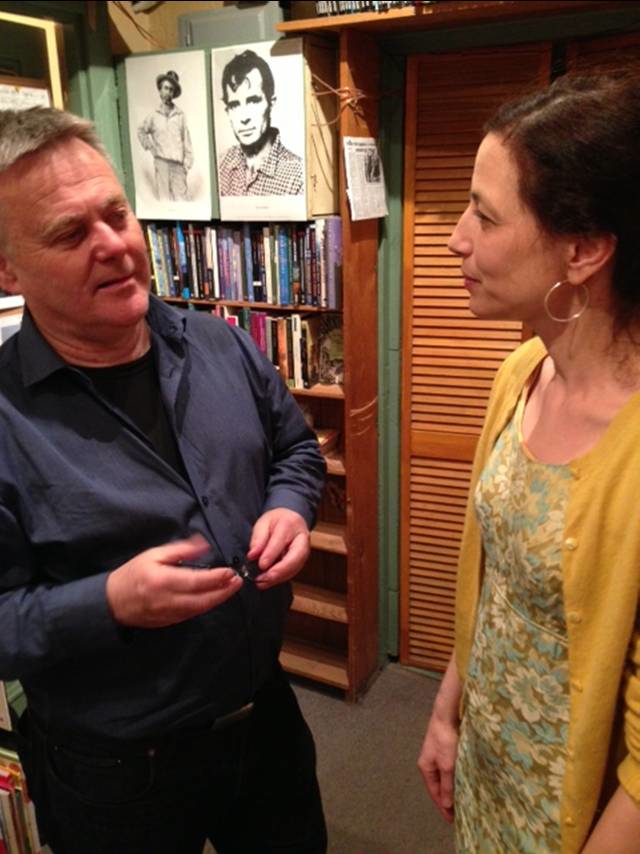
Mary Dalton and Don McKay

From right: Stan Dragland, Beth Follett and Leslie Vryenhoek

Wednesday, 24 April 2013

Patchwork Poetry


Working with Mary Dalton on her new collection, Hooking, brought into sharp relief how little I knew about the cento. Over at Oona, a blogger makes a case for the form's cultural relevance:
 In an age of sampling, remixes, & flarf, the renaissance of the cento, a form that dates, one way or another, at least to ancient Greece, is oddly apt. The possibilities of this kind of poetic collage are dizzying.
Marie Okáčová zooms in:
I believe that the cento, rather than being an eccentric curiosity devoid of all literary value, is primarily a kind of intricate and actually perfectly legitimate play with language, which reflects its principles of operation. Being in fact the embodiment of absolute intertextuality, the patchwork poems implicitly question every notion of literary originality because they emphasize the interdepenence of individual texts representing different literary meta-languages. The cento is therefore "recycled" art only in a more conspicuous way than the rest of literature inevitably is; this, however, does not mean that a work of literature can actually never be original and inventive. In fact, as an example of intertextuality par excellence, the patchwork poetry is, at least conceptually, a highly innovative literary form.

Sunday, 21 April 2013

Thursday, 18 April 2013

Hooking


Mary Dalton's collection of centos, Hookingarrived in the office yesterday. She launches her book tonight in Montreal at Argo (with special guest Sue Sinclair).  She reads in Ottawa on April 23 and Toronto on April 24. In an interview with John Barton, she explains the notion of authorship underlying the book:
I think of the lines I’ve excised from poems as material, as strips of words. Each line, the hooking of these words into this particular sequence on a line, is the creation of its individual author; the sum of the lines in each cento, the way in which these syntactical fragments have been hooked together, is my creation. These pieces are at once mine and not mine. They give rise to the question, where does originality lie?

Sunday, 31 March 2013

Sunday Poem

BRAID 
a.
There are others besides you who have worn that look—
peeking through the window-grille,
and in that place,
the mouth moving uniquely with each dialect.
Shall I tell you the secret
I braid by rote? Rough memories coiled like rope:
a fevered memory of
mild, mild eyes ricocheting off his fate;
a body riding up over the hood,
bleeding into the soft grass.

b.
This brings nobody peace, The ancient war
leads you through the streets of this shady city.
They somehow look as if they knew, except
the nude hills come back and the sleepless
stupid pupil, it has to take everything in.
After a while,
the matches, the wrong key-rings,
the lucky ticket with the right signs
are stuck. They can’t join the flag-waving;
they stiffen, when they should bend.

c.
Omega’s long last O, memory’s elision
jostle the vessel he cannot refill.
Even now she does the snake-hips with a hiss,
like a furious pink rabbit from a hat.
She buys up all
the notion of what his whiskers would feel like—
smack! Oh, attaboy, attaold boy.
Lost to TV reruns flickering overhead.
The point was to react,
to an ocean, or sorrow.

d.
You could be waiting for a tailor
that made the sky.
Listen: the heavens hiss—
and when one of the lookers Lily asked me what the hell
came late and will probably leave early,
I looked around at nothing.
Like an album: there: elf-child with dog—
little bastards. It was impossible to tell
and you are someplace else and thirty-three.
You’re running out of things to try.

e.
Mysterious voyagers from outer space
wrap their wings in sun-splints,
shuffle. They laugh together; their money shrinks.
That summer you got lost on a Nature Walk
or shrewd donkey,
to work green magic on my flesh.
Monarchs are falling,
trailing through ditches of water and nevus-ied grapes.
Dead bodies piled on the deck. On the sixth day
without you, the endless guessing.

From Hooking: A Book of Centos (2013) by Mary Dalton. (See book for source list of individual lines.)

Friday, 15 June 2012

Mary-Begot


In a major essay on her work, Fraser Sutherland celebrates Mary Dalton's use of a certain crystalline mineral:
"Given the omnipresence and omnipotence of salt in the history and geography of Newfoundland, it’s hardly surprising... that it has such prominence in the work of a poet so grounded in particulars as Mary Dalton. Adjectivally, it can also characterize her poems: they are salty. They are also saucy: impudent, bold, full of life. They take the idiom Dalton shares with her fellow Newfoundlanders, tempers it with her wide study of world poetry, and turns it to her own ends."

Saturday, 7 January 2012

Sparks and Cuffers

Mary Dalton, bookworm:

Zadie Smith and Michael Ondaatje (among others) said it exactly when they remarked that, if forced to choose between reading and writing, they would forego the writing. For me, too, reading is the vital act. And if this desert-island game were to go further, if the choice were between books and furniture, or books and a fine wardrobe, it’s the books that would stay.
Find the rest of Mary's Globe & Mail essay here.

Tuesday, 1 November 2011

Gift Horse Review

Quick off the mark, Quill & Quire has published a review of Gift Horse in its November 2011 issue (review isn't online yet). Meaghan Strimas describes Mark Callanan's poetry as
not fussy, nor is it driven by ego; it is humble, and it doesn’t take itself too seriously. It is, for the most part, blessedly free of sentimentality and filler. There is an exactitude to his art, displayed in the efficiency of his diction and his tightly organized stanzas.
(Love that hedging "for the most part.") Callanan and Mary Dalton read at the Atwater Library in Montreal as part of the Atwater Poetry Project on April 26, 2012 at 7 p.m

Sunday, 24 July 2011

Sunday Poem


THE BOAT

It was quite the rigamarole—
first the report of the broken boat
found high and dry in a bed of petunias,
then the tale of how it had sailed down
out of the heavens on a cold rainy Tuesday—
out of the great galvanized bucket of the heaving sky—
each of us knew what to make of it.
The mayor proposed a stern letter be written;
the councillor shuffled his ordinances.
The police dogs searched it for drugs.
The priest prayed for the drowned crew.
The biologist listed the worms and the sea-lice.
The woodcarver filled out some forms for the planks.
The camera man assembled his sepia lenses.
The psychologist warned of a wave of hysteria.
The evangelist read signs of the pending apocalypse.
The love-sick boy notched her name in the hull.
The real-estate agent cooked up a deal.
The historian ransacked his files for parallels.
The artist dreamt of a cottage conversion;
the politician sized up the tourist potential.
The carpenter said it was a big job to fix her;
the hardware men boxed up all sizes of nails.
The poet tossed off an exquisite ode;
the adman was sure he could mount a campaign.
Axe in hand, the fire chief rose to the occasion.
The pigeons were glad of a new perch.
It was quite the ballyhoo. Then,
while they were arguing among themselves
the boat lifted itself up out of their element,
into the blue—its battered planks clattering,
its twisted keel an inward grin—
and moved crazily on.
From Red Ledger (2006) by Mary Dalton

Sunday, 9 January 2011

Canadian Poetry Rebooted

It's finally here. Very happy to announce the Montreal launch of the controversial new anthology, Modern Canadian Poets, edited by Evan Jones and Todd Swift.

The evening will include readings by Evan Jones, Norm Sibum, Robyn Sarah, Anne Compton, Mary Dalton and David McGimpsey.

As anthologies go, this one is a big deal -- the first international one devoted to Canadian poetry in a half a century. Drop by and see what all the fuss is about.

Thursday January 13th 2011 from 7pm
Librairie Drawn & Quarterly
211 Bernard Ouest