Showing posts with label Don Coles. Show all posts

Sunday, 3 January 2016

Sunday, 28 June 2015

Sunday Poem


ASCHENBACH IN TORONTO

Every Wednesday she came by and
apologized like a schoolgirl
although she was not really late,
smiling and pushing back her long hair—
she had been reading Musil, or
Lessing, or, it could be, Mann, and
there might be some query about
the lecture of the day before, or
she would mention to him that moment
by the sea, on the beach at the Lido,
where the celebrated author is
hallucinating in his deck-chair, 
and by now they would be
undoing each other and
as their bodies came open
there would be only 
a minute or so left
for this, their mouths
pre-empted except for
slight and perfunctory 
syllables—
but still that image beckoned,
and still the little subdued slap
of the Adriatic mingled 
with the air-conditioning
so that even on the office couch, or
held up against some noticed space
when love was 
prompting her, she would see
what he had seen,
a kind of god, a stunning boy
on whom the sun paused 
turning to look back
from the curling shore, but
it meant nothing,
it was youth 
and she was impatient
with anyone who knew
so little. If she
could intercept 
that glance from the deck-chair,
oh, not to be seen by it but
to become it—
and at the thought of this, 
of pouring forth out of
that cache of mind, collecting
beach and sun and
stunning boy 
and returning inside to test these
against the thronged images
(think of it! always there, always
ardent for the light!) 
and teeming, stacked-up rhythms
of that severe, unswerving life,
why, she can hardly wait,
this is why she’s here, 
this is not Venice and
not exactly an aloof genius
either, but it’s the closest
she can get to 
things so boundless
she could spend her whole life
investigating them. As for him,
watching 
her dress and now the brief pause
and turn to look back towards him
from the door, he’s reminded of
something, a motion perhaps, 
some gesture, what is it, he wonders,
watching although she is gone,
he leans forward in his chair
by the sea.
From A Serious Call (Porcupine's Quill, 2015) by Don Coles

Thursday, 22 March 2012

Verbatim

"It’s an unwillingness to go along with what can, when you step back from it and take a hard, fresh look at it, be seen as a brutal primaeval agreement (what sort of halfway-sensitive creature could have put, on behalf of all of us, his or her signature to this?) that this is the rhythm the world is going to move to: things will be seen and then will be lost to sight, words will be spoken but at once succumb to silence, beings will be born and die, light will grow and then fade, all these will go, they’re already gone, just now they were here but no more. Why should this be?"

Don Coles explains the obsession with time in his poems.

Friday, 2 March 2012

A Casual Guy

In a long, penetrating review of Don Coles' Where We Might Have Been, David Godkin explores the strengths and weakness of Coles's style, which he defines as:
"a poetry that is relaxed, fluid and variable in the way that good prose is fluid and variable, a casualness that is indispensable to good conversation and absolutely central to that peculiarly Oxbridgean sensibility that unfolds from Coles’ longer episodic narratives. Chatty, charming, “offhand” as Margaret Atwood and others ardent fans have put it, Coles poems are not so much pressured from beneath by the urgency of what must be said as preempted by the impulse to charm and subtly provoke his readers."

Saturday, 17 December 2011

Holiday Recommendation, Ctd

In an entertaining round-up of "five newish Canadian poetry books," Rob Taylor recommends Where We Might Have Been by Don Coles, a poet he calls "the king of the killer ending." Read it here.

Tuesday, 1 November 2011

Tomas Tranströmer

My first real introduction to Tomas Tranströmer's genius was Don Coles' masterful translation of seventeen of his classic poems For the Living and the Dead (1996). Copies, I'm told, are still available.

Saturday, 14 May 2011

Saturday Poem

“…all our yesterdays have lighted fools
The way to dusky death.”

(Macbeth)

“Fools” is a little harsh, but
he knew to avoid sentimentality—
try substituting for it
and you’ll see why it’s there.
I sit on my sofa and watch,
through the back window,
the new red leaves of the Japanese maple
stir in a breeze so slight it would be
imperceptible without them.
To be eighty is also a little harsh.
I salute the red leaves and am
glad that I continue to distinguish
their small motions, although
I understand that neither they nor I
have lasting guarantees. Other leaves
with their impromptu ripplings
are on the way and
my semblable walks spryly
nearby, casting his eye about him
for where he’ll live next:
it’s a nice neighbourhood,
the young family who just moved in
next door will have a settled look
by then, and standing in their driveway
they will explain to him
the street’s idiosyncracies.
The word "plangency" has tempted me
more than once but I’ve resisted it.
These lines may always have been
its long-term goal.

From Where We Might Have Been (2010) by Don Coles

Wednesday, 11 May 2011

CAA Literary Awards


I'm happy to announce that Don Coles' Where We Might Have Been has been short-listed for The Canadian Authors Association Award for Poetry. Winners will be announced on June 23rd. More info here.

Thursday, 24 March 2011

Don Coles Reax, Ctd

The fine UK poet John McAuliffe seems very taken with Don Coles' Where We Might Have Been.
"Born in 1927, Don Coles began publishing poems in 1975 and over the past 35 years has produced ten books which possess a distinctive tone, both casual and observant, while fiercely arranging and sequencing those seeming casual observations to make beguiling poems which combine artifice and spontaneity with unusual conviction."
Read the rest here.

Friday, 18 June 2010

Coming Attractions


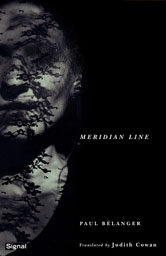
The covers above belong to the Signal Editions fall list. On the left is Meridian Line by Paul Belanger (translated from the French by Judith Cowan). On the right is Where We Might Have Been by Don Coles.

Belanger is publisher of Les Éditions du Noroît and one of Quebec's premier poets. I am immensely pleased to finally be able to include a translation of his poetry in the series.

Coles requires, I think, no introduction (though if you need one, this is a good place to start). With the recent death of P.K. Page, we might arguably call him Canada's greatest living English-language poet. But there is no argument about this: his upcoming book is a stunner.

Thursday, 5 February 2009

Don Coles blogs! Part 3


[Don Coles is the author of ten books of poetry and the novel Doctor Bloom's Story. He won the Governor General's Award for Poetry in 1993 for Forests of the Medieval World and the Trillium prize in 2000 for Kurgan. Formerly a professor at York University, he lives in Toronto. Periodically we'll post an entry by Coles taken from his 2007 book of essays and reviews, Dropped Glove in Regent Street: An Autobiography by Other Means ]

The last 20 anni have been pretty horribili for Bertolt Brecht’s reputation. His plays have faded offstage, his leftwing credentials have been called into question, his personal life qualifies as seriously bad news, in general his enemies have been noisily outshouting his supporters. Indeed it’s hard to know where to look for the latter nowadays. In the book Intellectuals, published a few years ago, Paul Johnson subtitled his Brecht chapter Heart of Ice and quoted Auden as calling BB “an odious person”. Brecht deserved the death sentence, Auden said, and added, “In fact I can imagine doing it to him myself.”

The chorus goes on. Thomas Mann, Theodor Adorno (who said Brecht spent hours every day putting dirt under his fingernails so he’d look like a worker), Marcuse, almost every known German contemporary and many more who are neither German nor contemporary, the judgment’s just about unanimous---flawed writer, flawed man.

I would like at this point to turn towards the Brecht I have one particularly private memory of. I remember one day a long while ago going into a theatre in Paris that was showing Mére Courage and then discovering (something I ought to have known before buying my ticket) that the company was Brecht’s own, the Berliner Ensemble from East Germany, and that therefore the production was being given in German. Of which language I did not understand a word.

This was depressing for about a quarter of an hour. In the next little while, though, without my asking myself why this was happening, the experience set about becoming as engrossing as anything—yes, anything—I’d ever known in a theatre; and it went on being so right up to the end of Act I. After the intermission all this repeated itself, the whole cycle: initial awareness, or remembering, that all this was in a language I had no access to, with its quite natural accompanying frustration; followed however within six or seven minutes by an immersion in the on-stage events that can be described in no milder way than utter attention (and a similarly ‘utter’ forgetting of any linguistic obstacle to my sharing in this experience). From then on the experience settled into being just plain marvelous until I was out in the Paris night again.

I’ve never forgotten that. What was going on on-stage, those archetypal movements of men and women and children, Mother Courage herself striding across Europe as the stage revolved through country after country—well, sophisticated dialogue was not what this was about; and although I’d never have guessed that anything this basic and primary-coloured would work with me or on me, work with and on me it did, and powerfully, movingly, and as you see, lastingly.

In other words the fact that I didn’t understand a word of German didn’t matter. Watching that stage, I forgot that I didn’t understand the language that was being spoken. And this, although as a personal admission or claim it’s of no interest, seems to me to matter here: that language never was nearly as central to the very great success of these plays as other components always were, components that Brecht may have been a near-genius in making use of; components such as, for instance, music; and, for another instance, a nearly unique sense of how certain basic human rhythms and rites (copulation, grief) can be invoked and presented on a stage and can then move an audience at a level beyond that which was, apparently, achievable by anybody else in this playwright’s lifetime.

(from A Dropped Glove in Regent Street: An Autobiography by Other Means by Don Coles, 2007)

Wednesday, 7 January 2009

Don Coles blogs! Part 2


[Don Coles is the author of ten books of poetry and the novel Doctor Bloom's Story. He won the Governor General's Award for Poetry in 1993 for Forests of the Medieval World and the Trillium prize in 2000 for Kurgan. Formerly a professor at York University, he lives in Toronto. Periodically we'll post an entry by Coles taken from his 2007 book of essays and reviews, Dropped Glove in Regent Street: An Autobiography by Other Means ]

Final Firenze memory, for me the most intimate. I had been strolling about the town that morning and had ended up on the crenellated roof-deck of the Palazzo Vecchio,the old City Hall, overlooking the town. Standing there I’d fallen into conversation with an American of about my age; he was newly arrived, I was a veritable fount of information regarding what lay below us. We decided to lunch together and I led the way to the Trattoria Camillo, a family-run place on Via Santo Spirito, very near my rooms on the via de’ Bardi. I’d been there a few times without anything noteworthy having taken place, just good food at a price a grantee like me could afford.


We took our places and ordered our antipasti. Waiting for it to arrive I suddenly remembered I didn’t have a lot of lire in my wallet; I took the wallet from my back pocket and had a surreptitious look. Right, merde, I had barely enough to pay for what I’d just ordered. Not a good discovery, sitting there with somebody I hardly knew, not good at all, but so far I could cover it. I was sure nobody had noticed any of this, people had been walking about and the place was busy. Antipasti gone, the signora arrived to take our next orders. My companion ordered a pasta and a glass of red wine, I said I was fine, not hungry, a carafe of water, nothing more, grazie. I half-thought the signora gave me a second look, but I wasn’t sure and I didn’t keep thinking it.

She left, was back again in minutes with not one but two plates of pasta and two glasses of chianti. I shook my head, said I’d ordered neither of these, she seemed too busy to listen and went off. I pondered this but after she’d gone determinedly past our table a couple of times without looking, I ate my pasta and enjoyed my wine. The pasta would soon have cooled past its best, after all. The American then ordered a salad, I declined, two salads arrived. By then I had given up. Lunch ended with two desserts, I don’t remember what these were, chocolate cake was what I normally liked and still do like along with red wine; and due cappuccini. We’d finished. I asked for our bills, they arrived. I got a quick look at his, it was in order, everything he’d had was listed. My bill was for that initial antipasti. Nothing more than that, nothing after that.

The signora, in passing, gave me a quick look when we were paying the grandmother who presided over the till. She didn’t wink, but she looked. It was a placid, friendly, everyday sort of look. The American had noticed nothing. I think he and I shook hands and parted as we left and
didn’t meet again.

I went back to Camillo’s a few days later and left a tip which covered my share of that meal. The signora may have noticed this, may not. My guess is that she did but there was no way of knowing. I have no memory of nodding or smiling or giving her a small bow or a meaningful, as they say, glance. I can remember none of those things but maybe one or two of them took place, impossible to confirm or deny that now. Camillo’s still exists but it’s gone gourmet, it caters to the monied classes and has a half-dozen waiters in white livery. The family has clearly exited the premises, I hope with their pockets stuffed. I hope that the signora, who can hardly still be of this world, had as calmly assured and sharp-eyed and generous (and perhaps, trusting) a series of days until her days ended.

(from A Dropped Glove in Regent Street: An Autobiography by Other Means by Don Coles, 2007)

Wednesday, 17 December 2008

Don Coles blogs!

[Don Coles is the author of ten books of poetry and the novel Doctor Bloom's Story. He won the Governor General's Award for Poetry in 1993 for Forests of the Medieval World and the Trillium prize in 2000 for Kurgan. Formerly a professor at York University, he lives in Toronto. Every Wednesday for the next two months, we'll post an entry by Coles taken from his 2007 book of essays and reviews, Dropped Glove in Regent Street: An Autobiography by Other Means ]

This is the sad story of myself grown old, a condition I did not strive after. Keats, Rimbaud, Plath (only one of whom I actually met) all demonstrate the value of an early departure—who wants to be the crazy old Ruskin or the rambling octogenarian Wordsworth or even the merely shaky May Sarton? And yet here I am, threescore-and-ten-plus, nobody can call me anything other than old and people have stopped trying.

Best, then, is to do as I do, don neutral-coloured clothing and stand at the fringes of whatever comes your way; no one is likely to ask your opinion or thrust a microphone at you anyway, they have more attractive options…and who blames them?

What makes me smile, nevertheless, a mirthless smile it goes without saying, is remembering, even as I step unresentfully back whenever some younger person wishes to stand where I am standing, how there was a time when…yes, reader, here it comes. When I was young! When I, too, was visible on a sidewalk!

The pathos of this old fellow’s unverifiable claim, you are now thinking, and again, I cannot blame you. Pathos indeed.

And yet I will tell you, for it’s too late to turn back now, that one afternoon walking up the via Tornabuoni in Florence, aged 22 and wearing a dark raincoat on a grey day, I saw approaching me down the via Tornabuoni a gaggle of people of whom only one was truly present to my gaze, this being a tall and blonde and carelessly sumptuous in her attire woman of about 35, English I felt and feel sure, closely guarded in her walking by three diminutive middle-aged men, all credible stand-ins for Carlo Ponti.

I stared unashamedly at this wonder and had a fleeting impression that she briefly returned my look just as the four of them left the sidewalk along which they had been approaching me, crossed the road, and disappeared into Doney’s Bar, a toney place halfway up the Tornabuoni and one I had never entered.

I stopped to watch them enter Doney’s Bar, feeling a formless lament, but feeling, also, not quite ready to start up walking again. So I loitered, I remember there was a florist’s where I was standing and I occasionally looked at a plant or two while I stood there. I have never had any interest in plants. It was then that the first of my two shameful and unforgiven acts—non-acts, as you will see—took place.


Because as I stood beside the florist’s window the blonde woman, unaccompanied now by any of the Carlo Ponti look-alikes, reappeared at Doney’s door and gazed directly across the street at me.

At me? This couldn’t be, I at once felt. I looked back at the florist’s window, someone must surely be signaling to her from within, desperately waving a bouquet of violets. But no, nothing moved within, no one appeared, there was only one person on the street and it was I. The woman was still standing there, gazing across. The Tornabuoni held its breath.

It had held its breath thousands of times before but at the moment this didn’t concern me. The woman said nothing, merely waited and looked. What was she supposed to do, wave? She had done her share, she had done all she could, I knew this. It was my turn, some signal, a quick run across the street, the exchange of a few words, a rendezvous, where, anywhere, down there by the Arno, in an hour, who cared, anything at all. I didn’t budge.

I did and said nothing.

Why not, didn’t I trust this? Here was the lustrous heroine of The Sun Also Rises, Lady Brett, her ancestral meadows spreading endlessly about her as obviously as the green curtains on Doney’s windows, and I was a stone. She looked, she waited a few more seconds, she turned and re-entered the bar. Thinking whatever she was thinking. And I—? Walked on my way, towards whatever exotic appointment awaited me. Picking up a reserved book at the American library, probably.

It gets worse. Some months later, back in London after my student year in Florence, walking up Regent Street on a pre-Christmas day, a few snowflakes testing the air, passing Austin Reed’s long storefront I noticed a small queue of people waiting at the bus stop. I wasn’t intent on catching a bus so I paid no attention, I merely continued to approach them. As I was in the act of passing them, something fell to the sidewalk just before my step. I paused, it was a woman’s glove.

I looked to see who had dropped it—the sky opened and fell upon me. It was Lady Brett. The blonde from the Via Tornbuoni. Beyond any doubt. Our eyes met. We were so close we could have embraced without moving anything but our arms. Across the road was the Café Royale, celebrated rendezvous of Waugh, Orwell, Connolly, heroes all: a place with small tables in tactfully positioned alcoves and the discreetest of waiters. You will not believe what happened next.

I did not pick up the glove. I paused, I didn’t want to step on it, after all. For a second or two it waited there. Then she bent to pick it up. I walked grotesquely on. Seconds later the bus arrived, and the queue, certainly including her, got on it. It rolled up Regent Street past me.


At this point I was almost staggering. Drowning in self-contempt. I tried to assure myself that we must meet again, surely this would happen, after all we had now had two meetings in a half-year, it must be fated, I would perhaps see her tomorrow, perhaps at this same bus stop. And never again would I fail her.

I was at that same bus stop at the same hour the next day, needless to say she was not. Or any other day, or on any other London or Florence street. Not that I know. Ever.

What does this have to do with old age? Nothing.

Something to do with youth, though.

(from A Dropped Glove in Regent Street: An Autobiography by Other Means by Don Coles, 2007)