- "Armadillo" by Ben Ladouceur
- "The Book of Materials" by Jeff Latosik
- "Longings Brittle as the Crooked" by Chad Campbell
- "This Little Piggy" by Katie Fewster-Yan
- From "Arrondissements" by Daryl Hine
- "Half" by Michael Prior
- "Mermaid" by Alessandra Naccarato
- "By Way of Explanation" by Raoul Fernandes
- "The Wound" by Zachariah Wells
- "Aschenbach in Toronto" by Don Coles
Breaking news. Literary exhortation. Entertainments. And occasionally the arcane.
Showing posts with label Daryl Hine. Show all posts
Sunday, 3 January 2016
10 Most Popular Sunday Poems from 2015
Monday, 28 September 2015
True Cosmopolitan
James Pollock, who recently edited The Essential Daryl Hines, describes the moment when his enthusiasm for Hines' poetry began to take hold:
Once I had tracked down all his books of poems, and read them all from cover to cover, I realized I had found the strongest Canadian poet of his generation, and one of the strongest Canadian poets of the twentieth century. Having just read, and been thoroughly persuaded by, Timothy Steele’s argument for the power of metrical verse in contemporary poetry—in his 1990 book Missing Measures: Modern Poetry and the Revolt against Meter—I was excited to find a compatriot who was so much more sophisticated and skilled in his prosody than any other Canadian poet I knew, even Jay Macpherson. And his knowledge of and engagement with such a wide range of poetic traditions—ancient Greek and Latin, Spanish baroque, Elizabethan, French, American—revealed him as a true cosmopolitan, a perfect antidote to the literary provincialism I’d winced at in so much Canadian poetry.
Sunday, 16 August 2015
Sunday Poem
FROM "ARRONDISSEMENTS"
1er Palais Royal
A foreign city in a foreign language:
Errors you will find your way around
Less by misconstruction of an image
Idiomatic as the underground
Than by reference to the lost and found
Out-of-date semantic luggage
And archaic sentimental slang which
Used to mean so much. Take care of the sound!
Dog-eared volumes of experience rebound ,
Sense can take care of itself. Abandoned baggage,
I sought to celebrate you, not confound;
Apart from the smarts you brought me, grand dommage,
A throne’s stowaway, you still astound
The razor’s edge dividing youth from age.
Xe Gare du Nord
Haunted by arrivals and departures ,
The desperate farewell of handkerchiefs,
This dingy greenhouse architecture nurtures
An exotic growth of greetings, griefs
And brief encounters under iron arches
Overlooked by smutty petroglyphs.
Having said goodbye to make-beliefs
And all a single backward glance can purchase,
Through the unsympathetic crowd one searches
Among reunions, tears and tiffs
And unfamiliarity that tortures
The traveller with interminable ifs
For those extraordinary features
Familiarity enfiefs.
XIVe Observatoire
Obvious from the Observatory,
After the abdication of the moon
Heaven explicates a bedtime story
Full of incident and interest, humane
Like anything significant to man,
The everlasting, transitory
Celestial phenomenon
In all its superannuated glory,
A roman fleuve that one is seldom sorry
To see abridged by dawn. The stars remain
Secure in their orbits, never in a hurry,
Worlds superior to yours and mine,
Dispassionate, explanatory,
Suggesting more than they can ever mean.
Friday, 14 August 2015
Matador of Art
Daryl Hine's poetry is often praised for its brio. James Pollock—whose "essential" selection of the late poet's work just been released—reminds us that there's much more to Hine's style:
The struggle of art against death is Hine’s great subject. As Edward Hirsch puts it in his book The Demon and the Angel, "highly formal and traditional work deepens immeasurably when one feels the primal murkiness threatening to swell up underneath the geometric clarity, the verbal concision and the ironic wit," and this is precisely true of Hine’s best poems. It is not so much that they "have duende" as the Spanish say; they are not inspired by death, exactly. Rather, they are engaged in what Hirsch calls "a hard-fought battle with the duende through formal means, in a formal arena ." In this sense Hine is like Horace and Paul Valery and Anthony Hecht: a matador of art, fighting the toro of death with consummate style.Pollock also corrects other misconceptions about those "formal means."
Hine’s poems are almost always written in some exact meter, and very frequently in rhyme, and they tend to favour a fairly complex syntax and erudite choice of diction, though the variety of his meters, stanzas, rhyme schemes, forms, sub-genres and verbal registers is spectacular. Precisely because of their prosodic formality and grammatical complexity, they should be read naturally, conversationally, and aloud. The mistake readers not used to this kind of verse often make is to overemphasize the regularity of the meter; in fact, Hine’s lines are full of metrical substitutions, enjambments and syntactical cadences that play against the meter in a counterpoint that Robert Frost called ‘the sound of sense’. It is not at all that Hine "composed in the sequence of the metronome", to borrow Pound’s phrase, but rather that readers raised on a steady monodiet of free verse sometimes mistakenly read him that way, if only at first. The pleasures of reading Hine well are so great that it is more than worth the effort to learn how. And the more one reads his best poems, the greater the pleasure.
Sunday, 28 April 2013
Sunday Poem
SAD LOG!
Triste Lignum!—Horace
Branches like a Bacchic dancer thrashed
Ever more furious and faster
Through the storm, then catastrophically crashed
Into my window, not the last disaster
But a mere mishap that may be mended.
No mere cataclysm ever ended
The war of winds, the travail of the trees
As they changed from ghastly green to grubby brown
Till, secretly subverted by disease,
They trembled to their roots and tumbled down,
As I shall do, one long-awaited day
When whatever wind will carry me away.
From Reliquary and Other Poems by Daryl Hine (Fitzhenry & Whiteside, 2013)
Saturday, 26 January 2013
Daryl Hine Remembered
The Malahat Review has dedicated its Winter 2012 issue to Daryl Hine, who passed away last summer. Hine's editor, Evan Jones, remembers the man:
Reluctant, withdrawn, grumpy, frustrated, and even frustrating, yes, at first. But as the years passed we became friends. His caregiver, Will Finley, told me Daryl would wait by the phone for me to call. Will teased Daryl about it. Phone calls were the basis of our overseas friendship. We would work on a manuscript, chat about the news or some recent review in the TLS—and we would gossip about poets. Daryl had stories about Auden and Bishop, Dudek, Layton, and Purdy. He had known Anne Wilkinson briefly and even met Dylan Thomas once in B.C. in the fifties. (Thomas offered him a “ciggy,” the butt of which Daryl kept with him for years.)
Labels:
Daryl Hine,
Evan Jones,
The Malahat Review
Wednesday, 22 August 2012
Daryl Hine 1936-2012

Here is the email I received from Evan Jones last night.
Daryl Hine passed away yesterday [April 20] in Evanston around 9:30pm. His health wasn't great, but he was stable. We spoke two weeks ago. He was at work on his own version of the Argonautica—from the ship's point of view. He had just bought a new MacBook. Daryl, Jay Macpherson and Virgil Burnett in one year. That's the end of something.Some excellent essays on Hines' work and career are available online. Here's one by Eric Ormsby, and another by Bill Coyle. Arc serves up only a morsel of James Pollock's piece (but you can dine on the whole thing in Pollock's upcoming collection of essays, out in November).
Labels:
Bill Coyle,
Daryl Hine,
Eric Ormsby,
Evan Jones,
James Pollock
Thursday, 22 December 2011
The Case For Daryl Hine
Bill Coyle makes it ("one of the most gifted poets alive")—but not without caveats:Too many times, I have had the experience of recommending Hine’s work to readers essentially in tune with his esthetic, only to have them report back that they find him remote, cold, mandarin to the point of unreadability. In distinguishing between those poems of his that contain an embarrassment of riches and those that are so rich as to be indigestible, then, I’m not so much trying to establish a Hine canon as assure new readers that such distinctions can profitably be made.Read the rest of Coyle's excellent essay here.
Thursday, 16 December 2010
Books of the Year
After providing year-end recommendations for 2008 and 2009, I thought I'd try something different this time. I asked some Signal poets (present and future) for books they enjoyed in the last twelve months. Here's what I got back.
I don’t know if I’d call it the “best” book of the year, and it wasn’t actually published in 2010 (so I’m delinquent on two accounts), but Luke Kennard’s The Harbour Beyond the Movie (Salt) is something that caught my attention earlier this year. I’d read his poem “The Murderer” in a Forward anthology a couple of years back and was blown away by it (Mob-style execution, multiple Tommy guns—think Sonny Corleone’s toll bridge death scene). It was one of those poems that confounds and delights, that makes one think: Oh, you can do that with poetry? Who knew? The whole collection, in fact, is exhilarating and disorienting, proceeding as it does by surreal narratives, like fun-house mirrors that make the familiar foreign, and in so doing, underline the modern world's many absurdities.
Mary Dalton
This year has been such that I've fallen a bit behind in reading the books of the year--am catching up on some of last year's, indeed. One that I thought highly of from 2009 is John Glenday's Grain (Picador) Daryl Hine's serial poem & (Fitzhenry & Whiteside) comes to mind among this year's books.Steven Heighton's Patient Frame (Anansi) is a formally elegant and morally resonant book, ranging in topics from the political to the domestic. The collection includes tributes to those who resisted evil, such as Warrant Officer Hugh Thompson, who stopped the My Lai massacre "as if to save was also labour/ for male arms", as well as to
The small-scale makers of precious obscurios—pomegranate spoons, conductors' batons, harpsichord tuning hammers, War of 1812 re-enactors' ramrods, hand-cranks for hurdy-gurdies.
It excoriates a child-molesting choir-master
who–while earth slowly unstrings a boyin his lento measure of staved ground—still savours the tangof August tomatoes, chords of Fauré’s Requiem(two years served, in fairway minimum)and the rectifying esteem of upstanding Ang-lican pals.
as well as pondering how and when one stops reading bedtime stories to one’s child:
How does the end enter? There's a hinginglike a book's sewn spine in the raw matterof time—that coded text, illegible—and stretched too far, it goes.
As these examples suggest, the book is full of those frissons of recognition that make reading poetry a way of reintroducing one to one's own soul.
Richard Greene
I'll plunk for Derek Walcott's White Egrets (FSG). Long line, large rhetoric, he takes the kind of risks that terrify Canadian poets. The form honours the largeness of an impassioned life. He grieves, he regrets, he returns from exile, he prepares to die, and he turns it all to music.
Jason Guriel
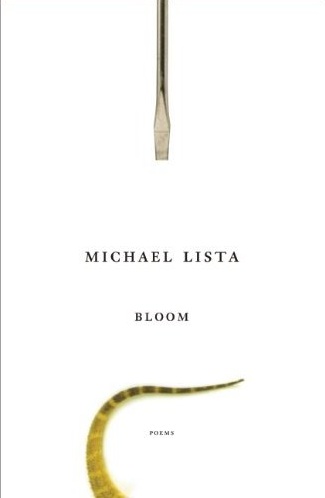
Bloom (Anansi) by Michael Lista is a first book of poetry that will give its creator no cause to wince in the years to come, and ought to put the rest of the literary world on notice. It isn’t juvenilia or, worse, promising. Instead, like Joyce’s Ulysses and Lennon and McCartney’s “A Day in the Life,” Lista’s assured book speaks fluently in various tongues as it takes the measure of an apocalyptic final day in one's scientist's quiet life.
Jason Guriel
I’ve been reading Christian Wiman’s third collection, Every Riven Thing (FSG), for a few years now, which is to say I’ve made sure to keep up with the magazines smart enough to publish its excerpts. Wiman writes instant classics that speak for themselves, speak about grief and God, and all but demand to be quoted: poems in which a tree “seems cast / in the form of a blast / that would have killed it,” and “leaves shush themselves like an audience,” and “wind seeks and sings every wound in the wood.”
Subscribe to:
Posts (Atom)