Showing posts with label Anita Lahey. Show all posts

Tuesday, 27 January 2015

The News That Stays News?


In her provocative preface to Best Canadian Poetry in English 2014, Anita Lahey explains the link between poetry and journalism:
The poet, like the journalist, is a conduit. And, like the journalist, the poet must stick to the truth. We are not, like fiction writers, necessarily making up plots. We are not, like essayists, necessarily arguing points or drawing conclu- sions. We are, like journalists, fact gatherers and posers of questions. We look, we ask, and we listen. We hunt down data of all kinds, from the intense emotional variety on down, or we simply await its approach: we take note, absorb, distill. We give it all back, rearranged in a way that, we hope, lets it speak clearly. We can mean different things when we speak of journalistic truth as opposed to poetic truth, but the basic realities upon which verse and metaphor are built are those that even poets, with their famously freewheeling ways, may not disregard. For a poet to exhort a reader to see, say, the unswept corner of a room in a new light, the poet cannot ignore the fundamental truths about such a place—indeed the poet must know these truths intimately, and the poet must understand, or at least sense, why he or she is compelled to call attention to them. When the poet directs our eye to the dust-ridden corner, and points behind that scene, or to an idea gathered within it, the poet is sharing important information with us, gleaned through rigorous research.
Lahey also proposes a deeper reason for the comparison. 
Amid global political and economic volatility, and in consequence of the vast breadth and reach of free digital media, the very fundamentals of the fourth estate, the tenets of free speech and the ideal of the journalist as society’s truth-teller are faltering. The work of actual journalists has somehow been left out of the budgetary models erecting around the new media. We are making do, more and more, with what I think of as sort-of journalism, almost journalism: sloppy and incomplete and inexperienced reporting, poor writing, rushed editing.  At the same time, counter-intuitively, something exciting is going on. The popular satire of comedians such as Jon Stewart and Stephen Colbert—even the homegrown satire in YouTube videos—provides many viewers with the double-whammy of current affairs embedded within their underlying absurdities and hypocrisies. Many people now chiefly get their news from such shows, or from strings of Twitter feeds, where events are filtered through tweeters’ reactions, which can be, often as not, linguistically creative and layered with meaning. This speaks to a growing sophistication in how a population living in a media-saturated culture learns to process information: lightning quick, able to synthesize, critique and reconstitute, all at once.  
The upside for poetry?
One, for all the handwringing over contemporary poetry’s supposed inaccessibility, readers are becoming ever more astute, and instinctively attuned to the types of tricks poets like to play: layering, juxtaposing, recasting, fragmenting. The corollary to this is that what poets do naturally should become more compelling and more relevant to potential readers, even nontraditional readers of poetry. Is this optimistic? Maybe. But the second thing the current climate means for poetry makes that optimism feel at least somewhat justified. As traditional journalism flails and its online incarnations scramble to find their way, the work of the poets becomes that much more important as a record and reconsideration of our times, past and present. There is and will continue to be, for the foreseeable future, an ever- increasing need for poets to be visible and to be heard in the general discourse. The more I see and feel this to be so, the more I find myself noticing, when I pick up a literary journal, that it’s in the lines and words and in-depth investigations of the poets where we can find, in large measure, the most urgent news of our day.

Saturday, 13 December 2014

No Mystery


Danny Jacobs unpacks some of the qualities that make Anita Lahey's book of criticism, The Mystery Shopping Cart, so special:
Lahey rarely falls into the common traps of the reviewer: vague descriptors, scant quotation, goofy swagger, and forced conclusions that result when a stumped or bored critic tries to jam the square peg of a poet into the round hole of a preconceived poetics. The outcome is essentially jargon-free reviews that contain adept interpretations of representative lines. Lahey is confident enough not to equivocate; she gets to the heart of what a poet is trying to do, and with aplomb—all we can ask for from a reviewer. When she’s on, when her enthusiasm is palpable on the page, she has a way of getting at a poet with just a line, a meaningful summing up in a deftly worded phrase: “Davies has a convincing way of turning one thing into another simply by letting us in on the revelation-in-progress” or “Though it fumes, [Owen’s] poetry does more; it has become that finely wrought thing on the other side of anger: what we call art.”
Jacobs also singles out one of the book's most intriguing aspects:
Throughout the book, Lahey makes the peculiar and perhaps risky choice of adding afterwords to most of the pieces. These short additions, no more than a page (often less), may grate on some readers. However, the afterwords ground the book and serve to connect the pieces through a “present” voice. Among other things, they are background tidbits, asides, second-guessings and admissions. After her long essay on P. K. Page, she amusingly tells us that she “tried the glosa and failed. Tried it time and again, with godawful results.” She sometimes questions her reviews in the afterwords (“Was it fair to review Avasilichioaei’s first book alongside her translation of Stanescu?”): the present self reviewing the past self. The afterwords remind us that reviews (and our opinions) are hardly holy writ, a valuable lesson in a book of criticism.

Wednesday, 14 May 2014

Something More


Anita Lahey has a meaty exchange with Phoebe Wang on the subject of poetry and poetry reviewing. Here are some favourite moments: 
When I’m coming to a book, I’m coming first as a reader, and having my own direct reaction to the book and what’s happening in it, and then when I sit down to write about it, I try to place my reaction to the book in a wider context. As opposed to starting with a theory or academic context, I’m starting with my visceral reaction to what I’ve read. I’m trying to be open and frank about what’s happening to me as a reader of that book, with the understanding that the person reading the review would know that—it might be different for them, and likely would be, because they’re a different person. And I think that’s important: I think a lot of the discussion that has been going on about reviewing and the way it’s supposed to work really underestimates readers, their understanding of the relationship between the reviewer and the book, and between them and the reviewer. They’re not blank slates that reviewers are putting their all-powerful assessments onto; they’re close readers in their own right, and will have an understanding that a reviewer is one person with a perspective.
As a writer—and I don’t know if other writers would feel this way—I want to know if my book didn’t work for someone for some reason. That’s something I’m really curious about. Because I want to reach a reader in some way. That’s part of the impulse of writing, to share, so I wouldn’t say that my own personal perspective has given me a perspective on the world of criticism—a hard reading is kind of an honour, in a way, because someone cares deeply enough about what you’re doing to give it the attention and time, and to think about it and read it that closely, and that’s a real gift.
I’m baffled by the debates that go on, that tend to have very narrow ideas of what’s okay, what should be allowed, what we should have left behind by now, or all of these things.They have these discussions in the music world, but we all seem okay with loving and listening to different kinds of music. That doesn’t preclude the fact that there are definitely such things as weak poems and bad poems, but why can’t there be many different kinds of really strong poems, just like there’s lots of different kinds of really strong music?
It’s that thing about poetry: you can never adequately articulate what makes a good poem because the whole magic of a poem is that it’s holding something you can’t articulate. So the best poems are the ones that, when you read them again, you see something that you didn’t see before. There’s room for you in that, because we’re always different in the sense that we’re amassing experience and things all the time, so when we’re going back to something, we’re going back to it slightly different than when we read it before. And if a poem is a good, strong one, it actually responds to that change somehow, so you get something more, or different, or you see something you didn’t like the last time.

Saturday, 5 April 2014

When We Talk About Poetry


Tracy Kyncl attended the “What We Talk About When We Talk About Poetry” panel in Toronto. She wonders if the assembled critics were too quick to dismiss social media:
Social media is too limiting, insofar as responses tend to be short, inflamed, and emotional. Journals, essays, and columns offer the room to expand analysis thoughtfully with clear evidence. But we return to the root of the problem again: who is being published in journals, newspapers, and in books, and why? If social media isn’t good enough, how else are marginalized readers and critics supposed to get a word in if established media outlets pay no attention to these ignored voices?
Ryan Pratt describes an interesting moment that occured at the Hamilton event:
Diversity of opinion is crucial to the growth of a literary community and, in a question that addressed W.H. Auden’s view that anyone who writes criticism should make clear his or her idea of Eden, different perspectives emerged – albeit in a politely Canadian way. Guriel populated his Eden with role models and metaphors studied during his adolescence. Lahey deemed hers as a space to engage with writing free from outside judgment. And Wells saw himself outside the garden with his back to Eden, seeking knowledge. Beyond the preferences with which each author treated their sacred place, it’s noteworthy that Guriel and Lahey embraced Eden while Wells saw it as “antithetical.” However innocent that icebreaker of a question was, it exposed an ideological fracture in the panel that subsequent topics would investigate.

Saturday, 29 March 2014

Friendly Talk


Norm Sibum sizes up the recent poet-critic panel discussion in Montreal (audio below)

I was told to smile and do friendly talk. Accordingly, I am smiling and doing friendly talk. Not that what follows is in any way important, literature not much more now than a spectator sport, as is any stand-off between barroom arm wrestlers. But even so, an evening vouchsafed to poetry by way of a panel of critics (who also write the stuff—poetry, that is); an evening consecrated to—what?—the explication of, the interpretation of, the bashing of, the treating with poems in some way or other; an evening devoted to the separating of stalwarts from dullards, was had at the Word Bookstore. It was had under the aegis of ‘What We Talk About When We Talk About Poetry’. Alright then. The panel, moderated by one of this fair nation’s leading literary lights, when all the dust had settled, seemed to have acquitted itself well. The Moesian thought so, and because he can be a surly bastard, I was inclined to take his ‘take’ on the matter. But then the man might have been preoccupied by the antics of Putin and American neo-libs gadding about in their stretch pants and limos, not to mention our very own Clown Prince and our very own Dragon Lady and the cartwheels they were effecting. In light of such events, how earth-shaking was this panel?

Friday, 21 March 2014

What We Talk About When We Talk About Poetry: Montreal

On March 19, 2014,  I moderated a poet-critic panel at The Word bookstore. Jason Guriel, Zach Wells and Anita Lahey debated the state of poetry reviewing in bare-knuckled fashion. Some blood was left on the floor.

From left: Carmine Starnino, Jason Guriel, Adrian King-Edwards, Zach Wells, Anita Lahey. 
Carmine Starnino, Jason Guriel
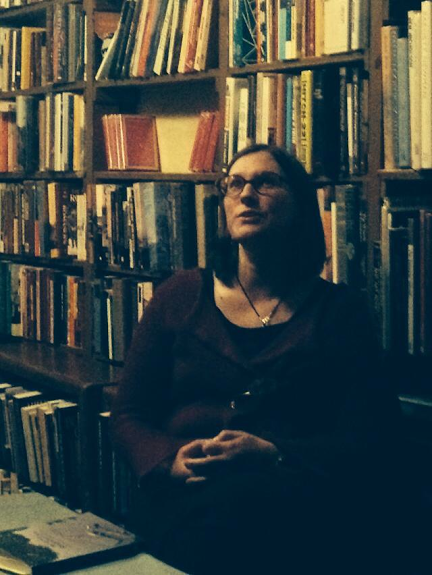
Anita Lahey
Norman Cornett, Carmine Starnino
Dimitri Nasrallah

Saturday, 12 October 2013

Giving a Damn

In an excerpt from her new book of essays, The Mystery Shopping Cart, Anita Lahey argues that writers—especially when it comes to reviews—need to toughen up:
An author’s ego may be a fierce and flimsy thing, but it’s not the reviewer’s job to mollify or tame it. As a writer, I know that when I put my work in the world, I’m letting it go: to be taken up, interpreted, misinterpreted, enjoyed, disdained or ignored as the case may be. If a reviewer doesn’t “get it,” that may be my own fault. If a reviewer is not caught by my subject, or finds my treatment of it clumsy, shallow or been-there-done-that, I want to be told. Sometimes a reviewer’s bluntness is a relief. This is not to condone nastiness or attacks disguised as reviews. We should never be blasé regarding someone’s heartfelt endeavour: humility and common sense demand basic awareness of the difficulty inherent in creating anything. But here’s the thing: I want to be challenged. By readers, by editors, by reviewers—by people who give a damn about what I’ve written and what I may be capable of writing and who make no bones about letting me know.

Friday, 21 December 2012

Little Animals


An unexpected find in a library leads Anita Lahey to rediscover Bruce Taylor's “Little Animals," a poem inspired by the microscopic explorations of 17th century Dutch scientist Antoni van Leeuwenhoek:
In “Little Animals,” Taylor’s narrator doesn’t just take van Leeuwenhoek’s word for it. He collects pondwater himself, with “a long-handled spoon” through a hole in the ice, brings it home and studies the creatures living within. “I have stared at them all week / in my Chinese miscroscope and have tried / to absorb what I saw.” He neglects his life, he confesses, to “spy” on theirs. He is hooked. Obsessed. Lost, yet found....Reading Taylor’s poem is as if, with him as guide, you are uncovering some of the most beguiling secrets of the universe. He is writing about discovery itself, and how it can be repeated, and maybe even how it must be.

Sunday, 9 September 2012

Lahey on Auden

Open Book: What one poem — from any time period — do you wish you had been the one to write?

Anita Lahey: W.H. Auden’s “Musée des Beaux Arts.” I love this poem more every time I read it, and something new comes to into focus each time. I picked it up before answering this question, and realized for the first time that the first line, “About suffering they were never wrong,” actually implies that the “Old Masters” did indeed get things wrong, perhaps many things, with which Auden himself would take issue. Yet he feels compelled to defend them regarding this one accomplishment, which is so crucial it cannot be denied and perhaps even erases some of those wrongs: they are not, to borrow Auden’s own phrasing from deeper in the poem “important failures.” I’m reading a great deal into that one line, but Auden’s wording invites it, here and throughout the poem, which is why the reading of it is always such a rich experience.

Read the rest here.

Monday, 25 June 2012

Canadian Women in the Literary Arts

I'm late getting to this, but there's a new outfit called Canadian Women in the Literary Arts (CWILA) that, among other things, has assigned itself the role of counting the gender balance in literary reviews and reviewing. The site has already been populated with a great deal of content, including a interesting interview with Michael Lista (who got a bit of a going over some weeks ago). It's too early to know if CWILA will make any sort of difference, though it did bring to mind some of my favourite critical writing by Canadian women available on the web. I'll try to update this list when I can.

Catherine Owen: "Chopped Potatoes"
Emily Landau: "Double Vision"

Wednesday, 18 April 2012

Verbatim

"For about four years in my mid-thirties my main form of exercise was to attend kickboxing classes at a dojo down the street from my home in the fantastic Ottawa neighbourhood of Hintonburg. It was confusing and exhilarating to learn how to move my arms and legs in combinations of offence and defence—as exciting as deciphering the nouns, verbs and grammatical structure of a new language."

Anita Lahey on her new book Spinning Side Kick.

Saturday, 31 March 2012

Lahey on Lahey

Anita Lahey speaks to Fiddlehead magazine about her new book Spinning Side Kick. She also offers up her top ten Canadian poetry books of the last decade.

Sunday, 8 January 2012

Fightin' Words

Natalie Zina Walschots has a short review of Anita Lahey's Spinning Side Kick in the Nov/Dec issue of This magazine (review not available online). The poems—many of which dramatize sexual politics and gender relations as a combat sport—seem to have excited Walschots' blood lust:
"The whole book gouges and gropes for weak spots...The men in these poems are slow as lordly walruses, clearly outclassed by the lean muscle in the voice of the book talking circles, fancy footwork, around them."

Sunday, 30 October 2011

Sunday Poem

JAB

It’s frank. The standoff ’s end,
pitch and gamble: a taunt. Shot
from the shoulder, the tightening
circumference of now. Oh

please. She’s bobbing
bravado and wrist wraps. Her guard
would let in a convoy of knuckles. It’ll be
a cinch, riding

the punchline into her
open mouth
through her forehead,
off her Vaselined

cheekbone. It goes to the head
like bad news, a word you wish
you’d never learned. Whore,
it smacks. Bitch. No good

cunt. It only takes one
to clear the way for all the hooks
and crosses you’re dying
to throw, screw

talking things through, touching up
the mascara. No more weeping
and gnashing in the change room.
Can you take it? My fist

wants to know. My fist
couldn’t hear you. How about now?


From Spinning Side Kick (2011) by Anita Lahey.

Sunday, 10 July 2011

Sunday Poem

THINGS THAT MIGHT PREVENT YOU FROM HANGING

the clothes out to dry: sore arms. A shortage
of pegs. High winds. Underwear trimmed
with lace. A snapped line. That feeling of unease

that arises when you see acrylic sleeves (yesterday
they held your own arms) emaciated, unable
to contain their nervousness. Mud. An absence

of nostalgia in your veins. You are shy and under
five feet. Tattered underwear, waistbands drawling. Bylaws
that forbid colourful displays of household chores. Fear

of stiff joints. Fatigue. Nightmares of being
dismembered. An addiction to the feathery smell
of fabric softener. Airborne pollution (orange, clinging

to cotton). Drizzle. Some misunderstanding with Sabine,
your cat. Lightning. Laziness (an automatic dryer
in the basement). Age. A lost button. You believe

in the roundness of the planet but don’t
trust it. The Wham! decal on that t-shirt you wear
only beneath other clothes. Freezing rain. Nightmares

about boys stealing your clothes off a rock
while you swim in the limestone quarry
at Hagersville. Sunburn. An unwillingness

to venture outdoors: You are nude, all your clothing
in the wash. A broken pulley. Squirrels. An inability to appreciate
old-fashioned labour. You eat corn chips and salsa

on Mondays. You hate to see the faithful upended in one long row,
fluids rushing, airheads pounding. It makes you want to cry.

Sunday, 21 November 2010

Coming Attractions


I’m nearly a month late in posting this, but I want to thank Jacob McArthur Mooney for including Mark Callanan’s upcoming book on his list of 2011 recommendations.

For anyone on the lookout for more CanPo offerings, we’ve assembled a really solid roster next year, with Asa Boxer and Linda Besner teaming up this Spring (her cover above). Anita Lahey joins Mark in the Fall.

I’ll be first in line for Julie Bruck’s Monkey Ranch, to be published by Brick (check out the Fall issue of Maisonneuve for some wonderful poems from the book). In the meantime, I’ll point poetry fans to the John Glassco biography A Gentleman of Pleasure, by Brian Busby, out in March from McGill-Queen's University Press, as well as my own selection of Glassco poems that Frog Hollow will be publishing around the same time.

Tuesday, 26 October 2010

Early Warning Systems


This friday, October 29, Asa Boxer, Anita Lahey and I will appear with three francophone poets (Vincent Charles Lambert, Rosalie Lessard, Thomas Mainguy) at a bilingual reading organized by DHC/ART Foundation as tribute to American artist Jenny Holzer. The event is called Early Warning Systems: Inflammatory Poetry by Six Montreal Poets (the title is lifted from one of Holzer's pieces), and it takes place in the Maxwell-Cummings Auditorium at the Musée des Beaux Arts de Montreal. 7pm. 1379 Sherbrooke Street W. Admission is free. Please come.


Thursday, 19 February 2009

Flash Interview #5: Anita Lahey

Anita Lahey has twice won the Great Blue Heron Poetry Contest, the Ralph Gustafson Prize for Best Poem, and first prize for poetry in Pagitica’s annual literary competition. Her poems have appeared in Ottawa buses as part of the Transpoetry competition, and in The New Canon: An Anthology of Canadian Poetry.

Her first book Out to Dry in Cape Breton (2006) was nominated for the Trillium Award for Poetry. Lahey is editor of Arc: Canada's Poetry Magazine and lives in Montreal.

The following interview was conducted by e-mail.

Carmine Starnino: When reading Out to Dry in Cape Breton, I was struck by the fact that I'd seen clotheslines cited in poems, but rarely read poems ABOUT clotheslines. Do you think, even after the recent flood of confessional/domestic verse, there still exist everyday subjects waiting to be discovered by poets?

Anita Lahey: Of course there are. I don't mean poems that rehash the same old territory in the same old way. But any object looked upon with absolute honesty, and perhaps with some measure of creative abandon, can be reinvented or turned inside out, or simply used as a worthy vehicle for an idea that needs to be shared. By which I mean, a good poet working in top form can both transform a dish rack and use that dish rack to convey something necessary, memorable or refreshing—hopefully all three.

CS: What aspect of Maritime life are you most happy you captured in the final poem that ends the book,"Cape Breton Relative."

AL: If I've captured anything at all in this poem, it has to do with the alluring, varied geography of the island. It is a combination of, on the one hand, the rough and the jagged (read: coastal cliffs, unforgiving tides, lots of swamp and forest untraversed by roads), and on the other, the gentle and welcoming (read: spongy mosses, windswept grasses, quiet rivers). This contrast emerges in some sense in the people as well. It's something I see in my own father, a Cape Bretoner, and in friends and relatives there. Like the rocks and the weather, these people won't let you get away with anything, they keep you on your toes. Like the softer elements of the landscape, they can be shockingly kind, but often in a shy and reserved way.

CS: As someone who wears three different hats, tell me: which "Anita" does the greedy poet resent most, the freelance writer or the editor?

AL: The editor generally has too many emails to respond to, and I would propose that, in our age, email—this habit we have of miraculously keeping conversations going with dozens of people at a time—is the scourge of the poet. It kills the quiet mind. The editor also has way too much poetry to read—not all of which is exciting or well-developed. But the poet in me probably competes with the freelance writer even more, because they are sharing brain space, fighting for the same kind of mental energy. They also both require generous helpings of uninterrupted time. That said, eventually, some aspect of all this other work feeds the poetry. It steals, but it gives back. I don't believe in the idea of the poet who hides away and doesn't engage with society. My work is one of the ways in which I do this. If I wasn't writing and editing for a living, maybe I would teach, or drive a bus, or learn to be a carpenter... I would find something to wield against the poet in me.

CS: Please give me a staple dish (with recipe ) that struggling poets need to know in order to stay healthy and hale during these recessionary times.

AL: I offer a dahl that will yield several meals, or feed several friends. It's nutritious, tasty and filling. It works for vegans, the lactose-intolerant, and people allergic to tomatoes—I have made it situations where all these factors simultaneously applied. Finally, it's easy and cheap to make. I have other dahl recipes that I like, but this is the one I use most often. (Apparently it's very easy to suddenly sound like a cookbook author.)

Dahl
500g dried red lentils
2 medium onions, finely chopped
6-7 cloves garlic, crushed
ginger (half the size of a golf ball), finely chopped
cumin, coriander and black mustard seeds (slightly crushed)
1 star anise
fresh coriander, chopped
olive oil
salt & pepper

Lightly fry the garlic and ginger in a small amount of oil. Add one teaspoon each of the crushed seeds. Once the mustard seeds start to pop, add the onion and soften slowly (don't caramelize them).

Once the onions are cooked, add the lentils, cover with water, and add the star anise as well as a generous amount of salt and pepper. (Add some chili powder or sauce if you wish.) Cook slowly, adding water when required. It's worth keeping a kettle full of boiled water for this purpose. Allow to cook for about 20 min.

Once lentils have begun to soften, remove star anise, and either mash or blend the mixture until it has a creamy consistency. Add fresh coriander and cook for a few more minutes.

Enjoy! (Preferably with a basmati rice and a beer.) Share or freeze extra! Return to your unfinished poem rejuvenated!

Sunday, 15 February 2009

The Vehicule Channel

Straight from Simon Dardick's camera, here are three YouTube clips of the January 28th panel discussion at The Word.