Showing posts with label The Winnipeg Review. Show all posts

Sunday, 11 January 2015

Total Goddamn Clusterfuck


Last February, Pasha Malla travelled to Montreal to attend the Canada Council for the Arts' National Forum on the Literary Arts. He expected that "having so many people in one room who share a passion for literature would make for some good conversations." In a cutting essay, he counts the ways he was disappointed.
What happened was closer to a 250-person choir in simultaneous competition to be the lone soloist. The roughly 400 takeaway points included: the calamitous loss of our independent bookstores; “the digital revolution;” the potential for libraries to operate as community hubs; the dearth of outlets for literary criticism; the lack of respect for the timeless art of spoken word poetry; the lousy food; and then there was some guy from Ottawa who told heartwarming, possibly rehearsed stories in both official languages about his unique relationship with books, and in private confided to me he’d not been able to tolerate living in Toronto’s east end “what with all the Indians.” In a similar vein, when I commented in my working group at the overwhelming whiteness of the delegation, and wondered if it was a fair representation of the country at large, I was told that I “need to get out of Toronto more.” So. Some diversity of thinking. As you might imagine, the result at times was nothing short of a total goddamn clusterfuck
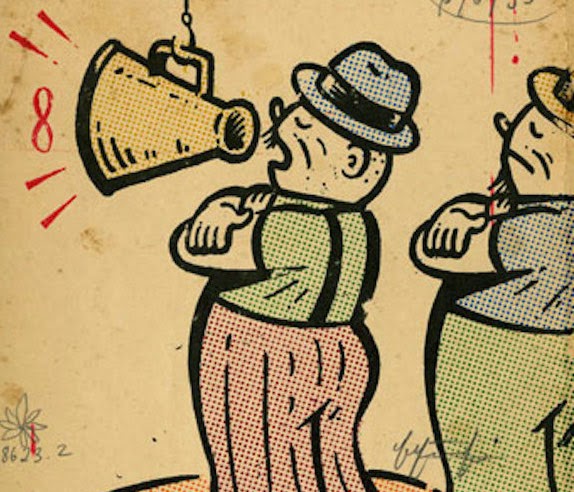
(illustration by Gary Taxali)

Sunday, 2 February 2014

Damn Lies


The reliably provocative R. M. Vaughan weighs in on Canadian literature. Some good bits:
I can remember having a conversation nine or ten years ago with my friend Andrew Pyper about how Canada has this chronic fear of so-called “genre” writing. Andrew writes these fantastic “mystery” novels—I don’t believe in these modifiers, but the industry insists on applying them. Yet if you think about it, every type of writing is “genre writing,” and what gets praised and awarded and over-rewarded in this country is in fact a genre of writing: the family domestic-trauma novel. And I would have hoped that by now, given that we have access to limitless amounts of information about writing from all over the world and in any available language, that Canadian publishing would start to reflect the fact that we have really good science fiction writers here, really good horror writers and action-adventure writers, and stop privileging the family trauma novel. But no.  
The alcoholic underclass abuse novel is a genre in this country—we just happen to have naturalized it as “Canadian literature” and it just won’t go away. I look at who gets awards every fall; everyone once in a while I’m shocked—but most of the time it’s just that really boring book about a sad family in some rural part of the country again. 
This notion out there that ordinary people aren’t capable of or qualified to talk about art: It’s a damn lie. It’s not real; it’s something we’re taught, it’s a learned thing. We live in a culture where we all watch pop-music videos, we all listen to contemporary music, we all watch movies and TV—we all engage in popular culture all the time and we all feel completely free to comment on it. By comparison, there is nothing special about art. It’s all on a continuum. After 40 or 50 years of conceptualism, people have been conned into thinking that only the educated elite are permitted to look at, understand and discuss art. If I can in any little way kick at that con game, I’m gonna do it.  
I was on a panel in late summer, I had only been back in Canada for about a month and I was asked to be on this panel with some other cultural-commentator types, and we were talking about an exhibition that was on in the city, one that I had mixed feelings about but that I mostly liked. Toward the end of the discussion, a prominent curator in the city stood up in the Q&A portion, and said that the way that I talked critically about culture made me the equivalent of the police officer who shot the kid on the streetcar...that is the level of crazy you encounter in a daily basis in the Canadian arts scene. And I think that is tied into the fact that we have made it all so precious. When you make culture seem like it’s the equivalent of, I don’t know, curing cancer, then of course people are going to get hysterical.

Tuesday, 1 January 2013

Portrait In A Convex Mirror


Turns out that John Ashbery's readings, as public events, are as eccentric and entertaining as his poetry:
"When Ashbery finished, his way had to be cleared once again. While Ashbery’s friend pushed his wheelchair, a photographer wearing multiple complex cameras duckwalked backwards, snapping pictures as if the poet were a runway model. It took me at least five minutes to round the corner to the exit, where the photographer stood cursing at Ashbery’s companion. 'I’m a fucking professional, I cleared it with his publicist, and he takes a swing at me?' Ashbery’s diminutive friend, who looked and dressed remarkably like Curly of The Three Stooges, simply stared at the photographer, who was a foot taller than he was. The friend’s crewcut head and flat eyes radiated menace as he pushed the elevator button to take Ashbery to the reception upstairs. The photographer stormed out onto the street."

Monday, 12 November 2012

Lazy Bastardism Reviewed


Jonathan Ball giveth...
"Starnino is a smart and savvy reader, with a stunning ability to attend to the smallest details. This fine sensibility allows Starnino, at his best, to recuperate the work of people that might actually need recuperating, like John Glassco, whose observation that “man ‘is destined for slaughter in the course of things’” won’t end up riding the bus anytime soon. Moreover, as everyone knows, Starnino shines on the attack. Here, he assaults Atwood, McKay, and Moritz. Although they are to some degree easy targets (Atwood for lazy languishment in simplistic political prose-with-line-breaks, McKay for devolving into self-parody, and Moritz for sham artistry), Starnino neatly dissects their development and the larger significance of the poetic trends they represent. At the same time, Starnino’s attacks are rarer, more nuanced, and fairer than in the earlier A Lover’s Quarrel (2004), and he has toned down the mean-spirited glee that sometimes surfaced in that earlier collection."
...and Jonathan Ball taketh away:
"The tragedy and triumph of Carmine Starnino are thus the same: once bitten, twice shy, he has avoided engagement with the avant-garde in this second collection. As a result, he has produced a better but less interesting book, because the real poets he should be grappling with are the ones that he does not understand, and so cannot engage. Everything Starnino loves in poetry—formal rigour, ambition, intellectual engagement with the world’s complexity, tactile and aural obsession with language—has become the domain of the avant-garde he hates."

Thursday, 21 June 2012

Verbatim

"I don’t believe it has any impact on the writing itself. It certainly has a tremendous impact on the culture and on the industry. But does it change the way writers work, on a day-to-day basis? There’s less hope, and writing feels more futile. Is that change? Unless attempted by deranged celebrities, writing always seems hopeless and futile."
Jonathan Ball on whether the dry spell of book reviews will affect Canadian writing.

Monday, 18 April 2011

The Death of Modern Canadian Poetry, Ctd

Evan Jones and Todd Swift hold their ground in this wide-ranging interview with Maurice Mierau on the subject of their anthology Modern Canadian Poets.

I've argued that the anthology -- by taking a wrecking ball to the existing CanPo canon and replacing it with scandalously neglected poets like A.G. Bailey and John Glassco -- is an exciting exercise in counterfactual speculation. But the editors aren't having any of it. "We were looking for poets who inhabited a Canada that does really exist: a place where, rather than reject the influence of the UK and the US, poets take on both, revealing a tradition inflected by its cultural position between two more dominant ones" [italics mine].

Point well taken (it's an argument I also make in the title essay of my book A Lover's Quarrel). And there's also this:
"[A] nation will always look differently from the outside. This is as true of Canada as it is of the UK, the US, Germany, Japan and New Zealand. There is no reason for poets to expect their tradition to resemble itself when viewed from another country: context has changed. We, as editors, are outside looking in; we have different expectations. Yet, we’re not interlopers. We have a direct connection and we see things differently, that’s all."
Read the rest of it here.