Showing posts with label interview. Show all posts

Sunday, 26 January 2014

The Most Inarticulate Buffalo In The World


Last month, I linked to a masterful interview with Daniel Mendelsohn. Here's another beaut, from the same magazine, with critic and editor Dwight Garner. It's chock-a-block with great anecdotes and insights. A sample:
Editing taught me the importance of quoting well. I’d like to think if there’s one thing that I do halfway decently, it’s quote others. It was Montaigne, I think, who compared quoting well to arranging other people’s flowers. I like writers who quote well and bring stray insight into their pieces. It’s like they’re pulling stars out of the sky.
When I was just starting out, one of the things I disliked most about journalists (and critics) is that you could learn more by talking to them for five minutes than you could by reading a year’s worth of their pieces. Their articles and essays seemed to me like masterpieces of indirection, of plausible deniability. I want to sound like I’m talking to a close, literate friend. In fact, I’m lucky to have had an amazing and ongoing email correspondence, across more than 15 years, with a great friend who is a writer. I want my reviews to sound not so different from the emails we pop back and forth. I want to be direct, and I want to make fine distinctions, and when appropriate I want to be funny. Humour is undervalued in criticism.
I was on a panel earlier this year with a well-known writer, and I was delighted when he announced about his favourite novels, “I’m a sentence queen.” He likes books that are alive on a cellular level, sentence-to-sentence. I’m suspect I’m a sentence queen, too, mostly. A terrific story is a terrific thing. But give me a great voice.
I’m envious of people who can open their mouths and have perfectly formed sentences and paragraphs come out. When I’m speaking in public—even right now, frankly—I’m inwardly wincing at every word that pops out of my mouth. I want to retract them all immediately, and re-phrase. Like so many people who write, I started because I wanted to gain possession of the things in my head that, when I opened my mouth, came out all wrong. Words are like little kids; you don’t want to send them out of the house until they’re dressed and have brushed their teeth. At a lectern I’m a fumbler, the most inarticulate buffalo in the world.
When I worked at the Book Review, we had a rule. A potential reviewer might say to us, “I can’t review X’s book because I know her.” We’d reply with this question: “Do you know the names of her children?” That was the litmus test. If you don’t know the names of someone’s kids, how close can you be?
When I was an editor at the Book Review, the idea of writing for the Times would make some writers freeze up. You’d assign them a book, then you’d talk to him or her on the phone a few weeks later and they’d say, “Why did you send me this steaming pile of dog waste? This book is criminally bad.” Then the review would come in and it would be eight paragraphs of the most tedious plot summary topped by a word like “lyrical.” I was often in the position of gently reminding reviewers, “You’re not writing this for the author’s mother. You’re writing it for the tens if not hundreds of thousands of serious and inquisitive people out there who will be reading you.”

Saturday, 26 January 2013

What Are The Benefits Of Pigheadedness?


Jason Guriel points them out:
Pigheadedness, at its most productive, can result in a kind of head-clearing loyalty to one’s gut reactions—and an allegedly self-destructive compulsion to air those reactions publicly. I say “allegedly” because I really do think that expressing an honest opinion about, say, the Griffin Poetry Prize ceremony or Dennis Lee can only be good for one’s health in the long term. What I mean is that the short-term negative effects of pigheadedness are outweighed by the lasting benefits of honesty. Pigheadedness makes far more enemies than allies—but they tend to be the right enemies, the right allies.

Thursday, 1 December 2011

Nick Thran

Dubbed "Genuinely, impossibly cool" in a recent review, Nick Thran attempts to define the term in a new interview:
'Cool' is one of those words that one can throw over a lot of more specific, helpful ones; a burlap sack kind of word. I guess maybe a more positive way for me to see the word cool would be as a kind of neon sticky-note on a page; a Whoa, this is something interesting and appealing in a way that I can’t quite articulate on first pass, but I’m going to come back to it soon with some more questions. Cool should be a precursor to a more rigorous engagement. It’s not, to my mind, a sustainable quality in and of itself.

Thursday, 24 November 2011

Palimpsest

Dawn Kresan opens up about her experience starting a literary press:
"My first four years of relative calm anonymity in publishing suddenly turned into a thrilling and terrifying rollercoaster. It’s a lot of ups and downs and I never know what is around the next corner. At this point, I am just trying to hang on."
Read the rest here.

Monday, 18 April 2011

The Death of Modern Canadian Poetry, Ctd

Evan Jones and Todd Swift hold their ground in this wide-ranging interview with Maurice Mierau on the subject of their anthology Modern Canadian Poets.

I've argued that the anthology -- by taking a wrecking ball to the existing CanPo canon and replacing it with scandalously neglected poets like A.G. Bailey and John Glassco -- is an exciting exercise in counterfactual speculation. But the editors aren't having any of it. "We were looking for poets who inhabited a Canada that does really exist: a place where, rather than reject the influence of the UK and the US, poets take on both, revealing a tradition inflected by its cultural position between two more dominant ones" [italics mine].

Point well taken (it's an argument I also make in the title essay of my book A Lover's Quarrel). And there's also this:
"[A] nation will always look differently from the outside. This is as true of Canada as it is of the UK, the US, Germany, Japan and New Zealand. There is no reason for poets to expect their tradition to resemble itself when viewed from another country: context has changed. We, as editors, are outside looking in; we have different expectations. Yet, we’re not interlopers. We have a direct connection and we see things differently, that’s all."
Read the rest of it here.

Friday, 15 April 2011

Green Day


Two more Richard Greene interviews have surfaced recently (aside from this one, I mean). A quickie with The Toronto Quarterly (which comes with a nice except from Boxing the Compass) and a longer chat with Rob McLennan, in which Richard describes his work as "an odd mix of religious vision, gags, social satire, and elegies." I wish I'd thought of that for the back cover!

Sunday, 12 October 2008

Closer to Home


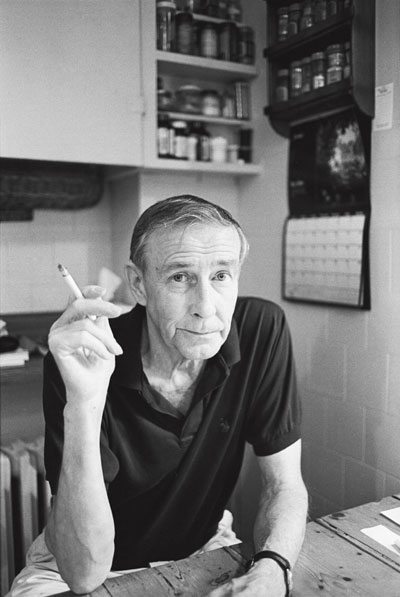
This photograph of North Hatley poet D.G. Jones was taken by Terence Byrnes, author of Closer to Home: The Author and the Author Portrait.
Don Denton has posted a wide-ranging and thoughtful interview with Byrnes on his site Literary Photographer.

LP: Your comments on the difference between photographing men and women were interesting, essentially that women are more sensitive about photographs of themselves. Care to comment on that further?

TB: Sure, but the word “sensitive” isolates women in a way that makes me a little uncomfortable. I’ll turn the tables for a moment and say that society finds endless ways to valorize men despite the way(s) they look. Male slackers, nerds, slobs, sexual indiscriminates, bikers, and outlaws can all find a place on the ladder of sexual status that Hollywood and society in general deliver to us. The range for women is much narrower and so often refers to their sexual availability (or not). Consequently, women have to be more “sensitive” because they’re judged by a different, and less flexible, standard.