Showing posts with label Todd Swift. Show all posts

Saturday, 16 March 2013

The YBPs


Pictured above is 30 year-old Luke Kennard, who Todd Swift argues is the standard bearer for a group of tyros he's dubbed The Young British Poets (YBPs). Swift has curated a selection of their poetry for the Winter 2013 issue of the online lit journal The Missing Slate. What sets the YBPs apart?
The YBPs of course emerge at a time of unprecedented social networking and digital over-stimulus. For them, the post-modern apprehension of ubiquity and omnipresence of cultural feed(ing) is a reality. All everything everywhere at once, their norm. As such, these poets are freer than in the past, to draw on outside or unlikely cultural influences.

Thursday, 6 December 2012

Dark Horse


I've put together a small selection of Canadian poets for the Autumn/Winter 2012 number of the excellent Scottish-American literary magazine The Dark Horse. I first heard of The Dark Horse in 1999 when, during a fellowship at the Hawthornden Castle, I paid Stewart Conn an afternoon visit at his home in Edinburgh. Just as I was about to leave, Stewart pressed a copy of the journal into my hands, and encouraged me to send them poems. I never did, but I finally meet the editor, Gerry Cambridge, at the West Chester Poetry Conference in 2010. I was there with Robyn Sarah, Bruce Taylor and Molly Peacock for a panel on Canadian poetry.  At one point during the conference, Gerry began distributing recent issues of the magazine, which, in the intervening years, had clearly taken a quantum leap in terms of design and direction. We struck up a series of conversations which continued into an email correspondance (I soon became a subscriber). I know Gerry would love to see more submissions—and subscribers!—from this side of the pond. A long review of Todd Swift and Evan Jones' anthology Modern Canadian Poets appeared in issue 26.

Sunday, 2 December 2012

Sunday Poem

SONNET 
No children;
Cold uncoils in the blood;
Science, true, not good
For you. So old,
Suddenly, or so young.
Lyric inside not to be sung.
Plug pulled, screen gone.
Sun out; mind
Bountiful, playing pain.
These are my children
In my head. Unbegotten.
This is to self-forget,
To have the future
Born forgotten.
From When All My Disappointments Came at Once (2012) by Todd Swift.

(Painting "Father and Child" by Georgianne Fastaia.)

Saturday, 24 November 2012

The Best Canadian Poetry 2012, Montreal Launch

One selling point, for me, of The Best Canadian Poetry 2012 is its robust selection of Montreal poets. Evidently I'm not alone in feeling that way. Turnout at the November 9th event, held at Argo books, was incredible, with many being turned away at the door. Photos courtesy of Meaghan Thurston.

Minutes before the reading

Poets waiting in the wings

Stephanie Bolster

Nyla Matuk

Kirya Marchand

Joshua Trotter

David McGimpsey

Asa Boxer

Geoffrey Cook

Todd Swift

The passing of the manuscript


Tuesday, 30 October 2012

Claptrap Canon


Zach Wells comes down very hard on the Carcanet anthology Modern Canadian Poets, accusing the editors of, among other things, incompetence:
Legend has it that expat poet and tireless poetry activist Todd Swift, in what he has referred to as his “Flashdance moment,” stood up at a conference in Norwich and hectored Schmidt publicly about his offhand dismissal of Canadian poetry. Schmidt’s response? He gave Swift, along with fellow expat Evan Jones, the chance to edit an anthology of Canadian poems for Schmidt’s Manchester-based press. A cynic might say that Schmidt’s gift to Swift and Jones was just enough rope.
Read Wells' review here. More on the anthology here and here.

Sunday, 12 August 2012

Verbatim

"I think there is a flattening of emotions, of depths, with anti-depressants. Fortunately, at lower doses, enough passion gets through, if perhaps not enough anxiety. One has to learn to cope with the new self. It’s about 85% of the old one."

Todd Swift on how anti-depressants helped his poetry.

Monday, 23 April 2012

Claptrap Canon, Ctd


Todd Swift, one of the co-editors of the Modern Canadian Poets anthology, responds to Zach Wells' review:
"His claim that our selection process was cack-handed is illogical. By definition, the one thing that editors of anthologies comprehend is who they include—we knew what we were doing. If Wells wishes to question our selections, so be it. But to have it both ways, to say our selections are both incompetent, and also mendacious, seems absurd. There is a glimpse of a different review here, when Wells actually admits that we have included some of the great, often unsung Canadian poems. However, the tireless editors are not credited with this. For that would imply that Wells would have to admit the existence of minds greater than his, working at some remove from his little train set—that is, the set of all things that include Wells."

Monday, 18 April 2011

The Death of Modern Canadian Poetry, Ctd

Evan Jones and Todd Swift hold their ground in this wide-ranging interview with Maurice Mierau on the subject of their anthology Modern Canadian Poets.

I've argued that the anthology -- by taking a wrecking ball to the existing CanPo canon and replacing it with scandalously neglected poets like A.G. Bailey and John Glassco -- is an exciting exercise in counterfactual speculation. But the editors aren't having any of it. "We were looking for poets who inhabited a Canada that does really exist: a place where, rather than reject the influence of the UK and the US, poets take on both, revealing a tradition inflected by its cultural position between two more dominant ones" [italics mine].

Point well taken (it's an argument I also make in the title essay of my book A Lover's Quarrel). And there's also this:
"[A] nation will always look differently from the outside. This is as true of Canada as it is of the UK, the US, Germany, Japan and New Zealand. There is no reason for poets to expect their tradition to resemble itself when viewed from another country: context has changed. We, as editors, are outside looking in; we have different expectations. Yet, we’re not interlopers. We have a direct connection and we see things differently, that’s all."
Read the rest of it here.

Friday, 8 April 2011

The Death of Modern Canadian Poetry

Here’s a really smart review by Jacob McArthur Mooney on the Modern Canadian Poets anthology. Jacob bills my recent Quill and Quire column as a “defense” of the Carcanet book, and, while I can see how you can read it that way, I was really trying to make a case for a growing number of younger poets—or “rebooters”—rediscovering and promoting neglected names. It’s an idea that seems to have caught fire (you might almost call it a generational effort) and I see the Carcanet anthology has a part of that trend. So the piece wasn’t meant to be a review of the anthology, per se.

Now, I can’t lie: I do get indecent pleasure from so many blue-chip names (McKay, Purdy, Atwood) being dropped. And I'm very grateful the editors included Coles, Bailey, Outram, Ormsby, Dalton and Partridge among others. But I don't want to ignore my frustrations with the book. I question some of the inclusions, from the bizarre (Joan Murray) to the you've-got-to-be-kidding me (David Moses). And I mourn the missing: Charles Bruce, D.G. Jones, Peter Van Toorn and David Solway.

But the Swift and Jones anthology is a lot like Donald Davie’s dream of rediscovering a “native” English-language tradition via Hardy. Or Yvor Winters’ alternative canonmaking (elevating Fulke Greville over Yeats). Or Ron Silliman’s “neglectrinos” (that subculture of the shunned). The editors, in other words, will argue that they are simply dramatizing an unrealized alternative. And they would be absolutely right. This is why comments about them getting it “wrong” miss the point. In a sense, Modern Canadian Poets can be called a counterfactual novel. By exaggerating certain facts and ignoring others, the anthology conjures an altered historical outcome for Canadian poetry—or at least gives us a glimpse into such a world. That’s why it sometimes makes more sense to treat anthologies like this as acts of make-believe rather than gate-keeping. As I’ve written before, the genre, by definition, is about making a statement through selection. And that statement is what you’d expect from any speculative fiction worth its salt: a radical break with the present.

Frankly, I think Swift and Jones have assembled probably the most daring Canadian anthology since Mainstream, which Peter Van Toorn completed in 1973 and never published (rumor is it was rejected). The only evidence of the anthology comes from the preface D.G. Jones was invited to write. It was eventually included in The Insecurity of Art: Essays on Poetics (1982) edited by Ken Norris and Peter Van Toorn. Here’s how the preface starts:
"Dear Peter,

This is a radical, challenging, fine anthology. It must meet quite a challenge after leaving out Roberts, Carman, D.C. Scott, A. J. M. Smith, P.K. Page and Margaret Avison, not to mention others still. Certainly, even on its own terms, some poems by these poets might be included, but I gather not enough from your point of view. In any case, I think your selection can meet the challenge and justify itself."
Doug, you took the words right out of my mouth.

Monday, 9 July 2007

Anglo-Quebec poetry buzz.

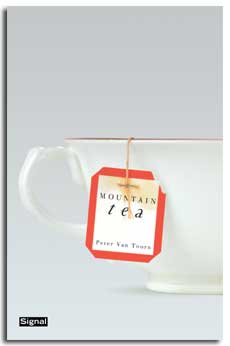
Peter Van Toorn’s Mountain Tea (first out in 1985, and rereleased in 2004) was one of the first rescue operations under Carmine Starnino’s editorship. It brought a new generation of readers to Van Toorn’s poetry and after three years enthusiasm for the book—and its poet—has yet to flag. To whit, here's a new interview with Van Toorn (thanks to CLM).

Also, Jason Camlot and Todd Swift, co-editors of the recent Language Acts: Anglo-Québec Poetry, 1976 to the 21st Century, are currently assembling a feature on Quebec's English language poets for the international online magazine Jacket. It's slated to appear in Autumn 2007.

In the spirit of things, we’d like to direct your attention to a rather special YouTube movie created by Barbara Golden who spent a couple of weeks in Greece with Irving Layton (thanks to The Danforth Review)