Showing posts with label Maisonneuve. Show all posts

Saturday, 21 February 2015

Ice Cream Poetics


In conversation with Laura Bast, Molly Peacock tries to define the "Canadianness" of her new book Alphabetique:
MP: Why would you call this book “Canadian”? Other than the fact that it was written in Canada. I think you could call it Canadian because of the contract with the reader. There’s a certain faith on the part of Canadians that the writer is going to lead the reader somewhere. This is opposed to the quick culture in the United States. In the quick culture, if you don’t see what the author intends immediately, you don’t have time to stop and find out. A reader’s reaction can almost be anger at that.

LB: Where do you think that difference comes from?

MP: How about an ice cream analogy? In New York, the number of brands and flavours of ice cream in a supermarket will be extravagant. Here, the economy doesn’t support the terrifying multiplicity of that variety. A person doesn’t have so much pressure on the choice button. So what has really interested me is that the reviewers of Alphabetique got it right away. Because there isn’t the same kind of pressure, because they had time to process this unusual, beautifully illustrated abecedarian book for adults.
(Painting by Wayne Thiebaud.) 

Sunday, 17 August 2014

Who the Hell Was This Al Purdy?


Drew Gough offers a stunning mediation on the experience of embracing a poet he once spurned:
For years, I’ve been looking for Al Purdy. But not before I spent years avoiding him, in the same way I avoided everything from the place where I grew up. I had the firm conviction that when you leave home—especially if home is a farm that doesn’t work as a farm, where the power is sometimes shut off because the electricity bill hasn’t been paid, on a laneway populated with tarot card readers, glass-blowers, playwrights and a woman firmly believed to be a witch, near a small town with no industry other than tourism and barely that anymore—you want to stay gone. You scorn home when it peeks its head into the new life you’ve built: during a casual run-in with an elementary school classmate on the streets of your new city, or when a poem about it appears on a third-year university syllabus. So entered Purdy into my early twenties, a lumbering force I was determined to dislike. “The Country North of Belleville?” When I said the name of his most famous poem in my head, it was always posed as a question. What, in the country north of Belleville, in the country I was trying to forget, could be worthy of a poem? What was there but rocks and hills and kind-of-pretty trees and funny names left behind by families who settled there and failed to build much? And who the hell was this Al Purdy?
(Photograph of Al Purdy's A-Frame cottage in Ameliasburgh, Ontario by Derek Shapton.)

Fighting Death with Excess


In a recent exchange with Michael Lista about his new collection, The Scarborough, Jason Guriel notices that, for a book with such a grim subject—one "trespassing on sacred ground," as Guriel puts it—the poems are "fizzing with style and formal energy." Lista explains that's not a coincidence.
One of my favourite moments in art, any art, period, of the last little while, was the final scene of this season’s finale of Mad Men, a show that I normally find too long on design and too short on art. Anyway (spoiler alert!), Bert Cooper has died while watching the moon landing and in the final moments of the show, his ghost returns to sing Don “The Best Things in Life Are Free,” replete with dancing girls and a soft shoe in socks. It was so beautifully human and stupid that I cried. It reminded me of a song from one of my favourite albums, Neutral Milk Hotel’s In The Aeroplane Over the Sea, the concept album about Anne Frank that I thought a lot about when I was writing The Scarborough; as the album builds towards its terrible finale in “Ghost,” Jeff Mangum sings: "I know that she will live forever / All goes on and on and on / And she goes /And now she knows she’ll never be afraid / To watch the morning paper blow / Into a hole where no one can escape." And then over the roaring reverb, a pipe organ and a bagpipe careen into a punk Barnum-and-Bailey Klezmer jig. It’s in moments like these, when death is met with a gaudy surplus of artistry, that you can see the fine membrane that separates art from religion, what Larkin called “That vast moth-eaten musical brocade/ Created to pretend we never die,” something he could never quite bring himself to sneer at because he realized he’d been knitting one for himself his whole life—his poetry. I’m a fan of any art—any poetry—that tries to do that, too, marshal a decorous consolation against emptiness.

Wednesday, 23 July 2014

Knuckleball Poetics


Over at Maisonneuve, Danny Jacobs and Daniel Renton trade some banter about new collections by Jason Guriel and Dani Couture. One of the best moments in the exchange belongs to Renton:
I do wonder if Guriel’s well-made box may be a bit of a ruse—his poems might be closer to being Chinese finger traps. That is, toys that snare unsuspecting victims who misunderstand their serious mission: to encourage us to relax our grandiose poetic posture and enjoy the play of language. Take this string of lines from “Knuckleball:" “its bottleneck— / the chewed-over / or coughed-up / or otherwise / indigestible morsel / of food for lines, / wobbly ones, / of thought.” Notice the purposely wound up syntax? The poem so mimics R. A. Dickey at the plate it practically wears a Blue Jay’s jersey.

Saturday, 3 November 2012

Maisonneuve Reviews Rhea Tregebov


"All Souls' (Signal Editions), Rhea Tregebov's seventh collection of poetry, unwraps the banal, beautiful experiences of a uniquely Canadian life. The lines are delicate but visceral: 'Soon / it will rain, soon wind will spread / the prairie dust, moths will give up / their lives against the glass,' Tregebov writes in 'House Work.' Tregebov's poems are thoughtful and confident, but never overreach. Her use of language is effortless, allowing the book to contemplate—sometimes quietly, sometimes more forcefully—the way in which small moments speak to a larger human consciousness." Taylor Tower, Maisonneuve, Issue 45.

Sunday, 1 January 2012

Sunday Poem

SERVICE RIG

Half these men are boys, like you are, but yell
so loud the cracks in their voices are hard to catch.
The other half, giants, older than the rig itself,
they knew this oil before it was black. A bare chest
here is thin and folded into itself a thousand times.

You’ve never seen them take the head off the pumpjack,
it’s clean in the dirt when you arrive, but you get to see
the service rig rising, the tongs turn on. Watch the youngest
man on crew climb the derrick and stand, harnessed,
coveralls dropped from his chest and tied with the sleeves
around his waist. Up where no one can yell at him to zip up,
no one can tell him to remember Charlie, where he can feel
the prairie wind beating his chest like the skinny fists
of a woman who almost wants him to let her go.
by Mathew Henderson, from Maisonneuve #42

(Photo: "Oil Rig Worker" by Richard Avedon.)

Saturday, 24 September 2011

Signal Spotting

Two Signal poets make an appearance in the Fall issue of Maisonneuve, now on newsstands. Nyla Matuk has two superb poems from her upcoming book, Sumptuary Laws, due out from us in Spring 2012 (a clutch of new work will also appear in the forthcoming CNQ 82). Jason Guriel has a stiletto-sharp take-down of last year's Harbourfront Battle of the Bards. Both pieces are behind the paywall, so you'll need to buy a copy. Or better yet, subscribe.

Thursday, 5 May 2011

Tomfoolery

Over at Maisonneuve, Natalie Thompson speaks to Linda Besner (self-portrait above) about her "attraction to accidental slippages of tongue":
"When I find those unintentional language slips I enjoy creating something intentional around them. Like putting something that is broken back together with the half it didn’t know it had."

Sunday, 3 April 2011

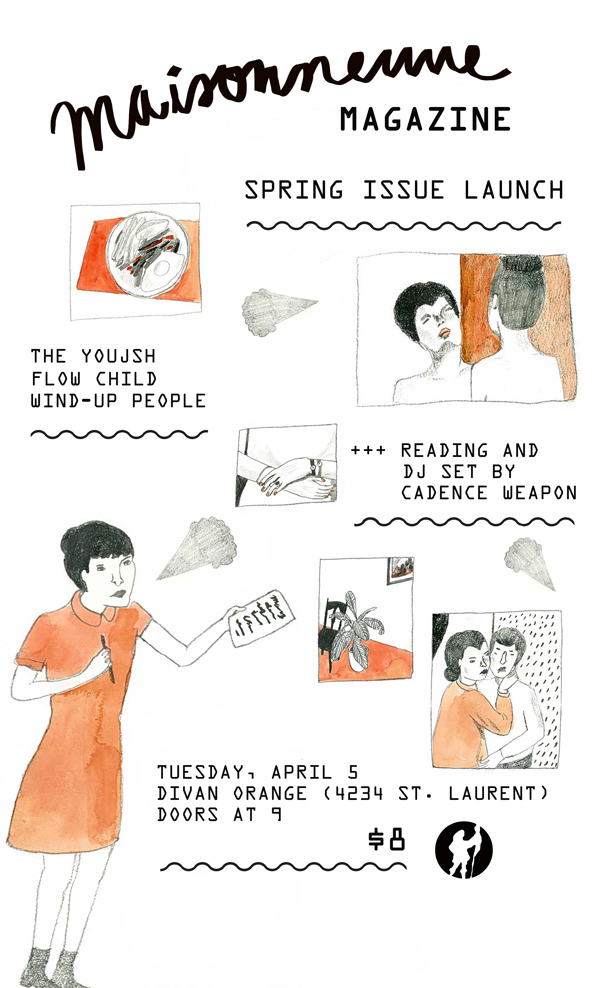
Maisonneuve Spring Launch


I love this poster. Drop by if you can, and support the new team. At the very least buy the damn issue.

Thursday, 31 March 2011

My Ears Are Burning


I'm very grateful to poets Jonathan Ball and Maurice Mierau for agreeing to chew over my bpNichol essay which appears in the new issue of Maisonneuve.

"I have long wondered why Starnino insists on writing at length about things he appears to hate, but although he is critical here toward the end, a real fondness for Nichol and an appreciation for aspects of his oeuvre shine through. Finally, some willingness to engage, which I find lacking in his other writings on the so-called avant-garde, which often, as they do here, descend into straw-man bullying."
You can read the rest it here.

Tuesday, 20 January 2009

The Good Soldier


Signal poet Asa Boxer's fascinating 2007 article on his stint in the IDF has just gone live on the Maisonneuve website.

"In 1993, I packed a rucksack and hopped on a flight to Israel to seek my fortune. It was the year of the Oslo Accord. I still recall the images: a trembly Arafat hesitating, then refusing to sign one of the pages at the last moment; Rabin’s reluctant handshake afterward; and, of course, Clinton’s beaming face overseeing the televised episode. For the next four years (which included Rabin’s assassination and Netanyahu’s rise to power), Israelis were able to focus on more than survival. It was a period of economic boom, despite the regular bus bombings in Jerusalem where I finally settled."

Read the rest here.

Saturday, 6 December 2008

Quick cover your eyes!

I've got a few editorial hats, and one of them belongs to Maisonneuve magazine. Our new issue is now on the stands and it includes a personal essay called "What We Eat" by rising star Pasha Malla concerning a bizarre video of a pelican in London that chows down a live pigeon. Pasha's piece is hilarious, but knowing what I know about the cheeky duplicities of his writing -- he writes what some academics would jargonize as "autobiografiction" -- I had my doubts about veracity of that video. Turns out the damn thing exists. And here it is (it's worth getting your hands on a copy of the mag to find out what Pasha has to say about it).

Saturday, 29 November 2008

Effin' good

I'm a little late with this, but want to put in a good word for the second issue of Riddle Fence, the smart new Newfoundland literary magazine. A couple of Signal poets make an appearance. Jason Guriel (whose Pure Product is slated for Spring 2009) reviews George Murray's The Rush to Here, and John Steffler (Helix: New and Selected Poems) has four poems.

Highlights also include poetry by the now Montreal-based Danielle Devereaux ("You'll know me when I'm / an old woman. I'll be the one with ratty / fingernails. Jowls."), David O'Meara ("The numbers predict tomorrow / will be cold, with a chance of rain") and David Hickey's hilarious baker ditty ("Even the baker hates me now / Even the baker hates me / Even the baker hates me now / For sins against Lord Bread").

The standout piece, however, is novelist Joel Thomas Hynes' torrentially abusive manifesto, "God Help Thee." Maisonneuve has bravely reprinted it on their website. Or you can hear Hynes' recitation of it -- as well as purchase the MP3 download -- at Riddle Fence.