Showing posts with label CNQ. Show all posts

Wednesday, 11 March 2015

Noblesse Oblige


The Spring 2015 issue of CNQ includes a deeply considered, hard-hitting 12,000-word essay by Alex Good (not yet online) on Canlit's ruling gerontocracy. He argues, among other things, that Canada's worship of its literary establishment—the hard-won creation of millions of dollars in grants and a colluding academic industry—is crushing the ability of interesting new careers to properly take root. The essay begins with a description of Alice Munro's decision to pull out of the 2009 Giller prize—an act, Good goes on to explain, that should have given us serious pause.
As Canada’s literary award season started to gear up in the fall of 2009, a polite bombshell was dropped on the media oddsmakers. Alice Munro, widely recognized as not just one of Canada’s top authors but as one of the greatest writers working in the English language (she had already won the Man Booker International Prize for her lifetime body of work, and in 2013 would go on to win the Nobel Prize for Literature), withdrew her new collection of short stories, Too Much Happiness, from consideration for the ScotiaBank Giller Prize. She had already taken home the Giller twice, and the Governor-General’s Award for Fiction three times, and, it seemed, had had enough of awards.

Such a withdrawal was not without precedent. Both Munro and Margaret Atwood had previously removed their books from Giller consideration, but that was because they were also serving on the jury that year (only a slight conflict of interest, given the history of prize). The reason Munro gave for pulling out of the contest in 2009, however, was noteworthy. “Her reason is that she has won twice and would like to leave the field to younger writers,” her publisher explained.

Munro’s decision was applauded in the media for its generosity, and understandably so. But her statement also dramatically laid bare the thinness of the field she was leaving open. Meryl Streep found herself nominated for a Best Actress Oscar for her role in the film Julie and Julia in 2009, despite having already received 15 Academy Award nominations, more than any other actor in history (she would win for the third time in 2012). Should she have withdrawn her name from consideration in order to leave the Oscars open to younger talent? That would not have gone down quite so well. And yet in the run-up to the prize that had established itself (at no small expense) as Canada’s most prestigious literary award, Munro’s act of noblesse oblige was simply accepted for what it was: a recognition of the foregone conclusion that with her in the race, no younger Canadian writer (and, at 78 years old, the field of “younger writers” was rather large), would have had much of a chance. The winner’s name would, in turn, forever have an asterisk beside it, like a baseball record from the steroid era.  

Saturday, 27 December 2014

The Grand Seduction


In his interview with me, Michael Harris explains some of his methods when editing the Signal series:
A first line literally has to have one hooked immediately. Without a first line that either leads in immediately to a second line hook or a third line hook, there isn’t any poem, you don’t get down to the fourth line usually. It has to be something that doesn’t throw one off. It has to actually bring one in. Reading a poem is a little bit like falling in love. Ten years on, if it was a correct falling-in-love you’re still with them and if it was an incorrect falling-in-love, you’re not with them anymore.

C: Does that thinking affect arrangement in a book? For example, the first poem you place in your manuscript?

M: A friend of mine, the Quebecois poet Michel Garneau, once told me, “Lead with your best piece.” And that makes a kind of sense. He is, amongst other things, an actor and a playwright. And theatrically, what’s interesting is to have something very strong at the beginning. But I don’t think the first poem in a book has to be the best poem. It has to be a poem that is absolutely solid, that doesn’t push one away, that says, “Here I am. I’m a decently written piece. I have subject matter that’s of interest. I have a couple of oddities. A couple of interesting tropes that tell you I’m an interesting poet beyond what one might normally read.” And by the end of the first page, you have to have read something of import. Then the second page and the 3rd page and the 4th page, you can fool around a bit. By the time the 5th or 6th page, then you have to have a plateau poem, a decent poem, a very good poem. Something that’s so good that, had you put it first, you might have lost the reader; it’s a little bit like getting introduced to somebody you don’t know and coming on too strong. That’s how Shakespeare managed the plays. Very seldom is the huge speech in Act 1. The magic develops slowly. By the time you get to Act 3 or 4 there’s strength, power and explosiveness.

C: You don’t want to come on too strong?

M: You want to be absolutely present and inevitable, but you can’t whack somebody over the head and say this is genius. At least, that’s how I would organize the seduction.

Friday, 7 June 2013

Street View


Michael Schmidt became briefly infamous in Canada in 1998 for two words that appeared in his 900-page book on the history of English-language poetry Lives of the Poets. In that study—which included mention of only a couple of Canadian poets—the Manchester-based poet and critic dismissed Canadian poetry as a "short street." An interview with Schmidt appears in CNQ 87 which revisits that controversy and covers other aspects of Schmidt's thoughts on Canadian literature. The interview, conducted by Evan Jones, isn't available online, but here are some highlights.

On the dearth of Canadian poets from his 1998 study:
I’m afraid that when you are doing an international historical survey a lot of local darlings get neglected because in that context they are invisible. Lives of the Poets started from a hypothesis of continuities, between poems and between poets, between seemingly discrete literatures. There are major poets who work well beyond borders, and there are those who don’t. Ashbery versus Ammons, for example, or Larkin versus Betjeman. This doesn’t mean that a local or national poetry is necessarily enervated or lacking in shape and even distinction; but the absence of substantial figures to appeal to a visiting reader (I was not the first to stand at Seven Dials and reach such a conclusion) with a very large wave of poetry carrying me forward from the fourteenth century, is what I was experiencing. Much as I admired Margaret Atwood as a wry presence and novelist, her poetry did not seem very good to me. Anne Carson was not at that time where she is today. Mark Strand and Elizabeth Bishop had shaken the dust of Canada off their feet. Earle Birney seemed a colossal joke, a product of Arts Council policy. I have long admired Klein, as you know. So I was a traveller from an antique land and I was looking for mountains or monuments or at least enormous feet of stone
On Earle Birney:
I think I heard him at a Poetry International back in the 1960s or early 1970s. He was the Canadian poet everyone had heard of, the one Canada promoted as the Voice of the Nation. It is possible that I enjoyed his reading. Someone, a publisher or the Canada Council, sent me a very heavy and substantial two volume edition of his poems, hardback and boxed like a Folio Society classic. There was his ‘David’, carried away by its sounds. The problem is that they are, many of them, especially the thick alliterations and assonances, overdone. The effect is achieved and then overwritten again and again. In this case Poe’s prescription is right about the extent of poems, and the treachery of narrative when the impulse is, as I take it to be here, essentially lyrical-elegiac. There were also many poems about his travels for representing Canada. Poetry as diplomacy, poetry as outreach, poetry not as journalism—it did not have that kind of precision—but as enthusiasm, with descriptions of things or of how things affected the travelling bard. My sense was that the whole thing was too easy: the writing, the editing, the publishing, the binding, the privileging. The man was a living monument, but not like A.D. Hope a poet of formal and thematic substance, or like James K. Baxter a volatile genius. It didn’t seem serious.
On hybridity:
Hybridity nowadays is deliberate, a matter of choice and design, treating the genetic chain like rosary beads. Formal choices seem often to be preceded by political calculations.
On anthologies:
You mention anthologies, a subject dear to my heart. Anthologies of poetry needn’t be indiscriminate. They may be bigger because the anthologist rebels against the Golden Treasury approach and feels that if a poet is worth including s/he is worth reading in extenso. For my part, I subscribe as a reader and as an editor to Thom Gunn’s ‘spectrum’ argument which he proposed eloquently in an essay in PN Review, demonstrating a continuity in American poetry from the work of Edgar Bowers at one extreme to that of Michael Palmer at the other, with gradations between. It is this sense not of oppositions, cliques, encampments or interest groups, but of contiguous and interdependent strata. It’s the sort of approach that leads to [Carmine] Starnino’s kind of anthology (which I do find a little too optimistic in its harvest of fifty poets from two decades, but still compelling in its intelligence), but not to [Roddy] Lumsden’s. There are borders, of course, but they are permeable. Note that Starnino’s title proposes a canon, which implies the creation of a diverse, common and authoritative poetry; Lumsden’s proposes a triumphal parade of discreet identities, marching obediently forward. A generational victory parade.
How he would revise Live of the Poets today;
If I was to be revising LotP, of course, I would be under various constraints, not least that of space, and I am not sure how long the comparative street would be, or how Canadian with a Capital C it could be given that so many Canadian poets are Canadian more because of the deliberate erasure of another nationality, or by nurture not nature… I wonder how many Canadian poets insist on Canadianness, and how many are marshalled into that category by those who want to consolidate the notion of a distinctive and definable Canadian poetry? 
On prizes:
On the whole, prize culture, like performance culture, seems to me a distorting thing. Many poets can’t perform and most poets don’t win prizes. The creation of a culture of plausibility becomes restrictive. The fruits are obedience, writers writing for toffee apples, as in fiction the presence of the big screen and its rewards actually impacted on the pacing and texturing of novels. Odd how many novelists, for two long generations, made some of their money from script writing, and the lucky ones from film deals. Performance and prize culture are aspects of the commodification of poetry and the dumbing down, the decorum of relevance and accessibility.

Friday, 29 March 2013

Bit Player


CNQ has made available the first chapter of Andrew Steinmetz's soon-to-be-published This Great Escape: The Case of Michael Paryla, a book that exquisitely unravels the mystery of his late uncle who had a brief cameo as a Gestapo agent in John Sturge's famous film The Great Escape.
He’s had perhaps a minute on-screen in one of the most watched war movies of all time. Yet as a bit player he is uncredited for the role. In fact, soon after the film was made, he disappeared completely. Shortly after his star flickered, he died, aged 32, from a drug overdose in Hamburg. Watched by millions yet almost completely unknown. And there’s a further irony. He was a refugee from Nazi Germany, partly Jewish and the son of one of Germany’s most famous left-wing actors, playing a Gestapo agent, a role reprised on thousands of television repeats. 
In fact, watching television is how I came to know of my uncle Michael. Alive but not living, stranded in the no man’s land of a motion picture. His character was staged and scripted, but I was spellbound—Michael was convincing. Fedora and trench coat. Elegant. Blond. His smooth transitions. His lively walk, his coat unbuttoned, his fashion the casual flair of some fresh-as-the-breeze fascist. This image, I now understand, years later, is counterfeit, a convenient archetype, manufactured by the American film director John Sturges and his sidekick Bert Hendrickson in Costume Design and Wardrobe. But it is him, close enough to the real thing. 

Sunday, 11 December 2011

Sunday Poem


DON DRAPER

—after Lavinia Greenlaw


Moths feather your far gazebo
like young sailors on first leave.
You know something, and keep reminding me

of my own needs. You see an audience
of blooming heads and sugared bank notes,
and act accordingly. The swallows see it at five o’clock,

a Wolfman’s tragedy.
They hang themselves upside down,
handsome sienna prizes in the semaphore of bats.

Swayed by a summer night, I swing out
to your silk pocket square standing at attention,
a bird about-face. You’re the dark dew on the green grass of home.
by Nyla Matuk, from CNQ #83.

Saturday, 8 October 2011

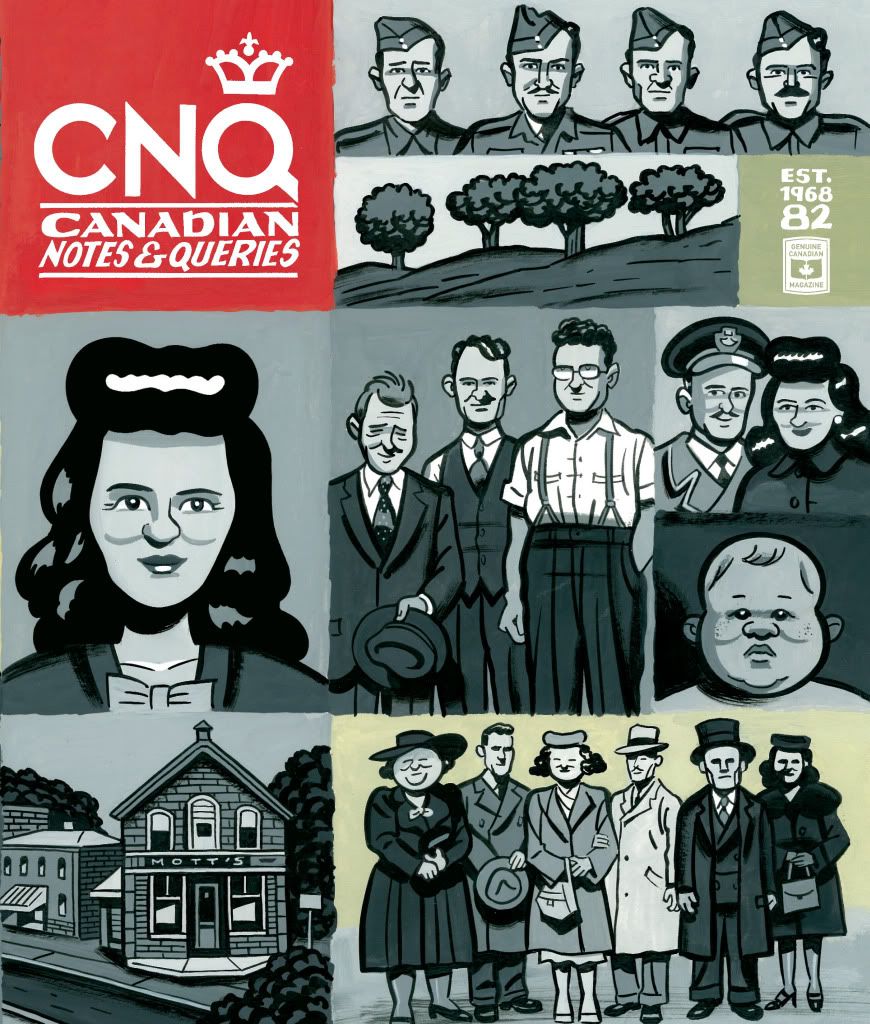
CNQ 82

My copy of CNQ 82 finally arrived last week. Hard to overpraise or even do justice to it. There isn’t a dull piece in the issue, from the Seth cover that goes bang in the eye to Marius Kociejowski's anecdote-brimming, name-dropping memoir about his life as a rare books dealer (his account of Annie Lennox walking into his shop is priceless). There are a clutch of dazzling poems by Laura Lush (full disclosure: I’m the CNQ poetry editor), as well as penetrating reviews by Nyla Matuk and Shane Neilson. There's also a shrewd, helpful piece by Nigel Beale on where to look for the penny-stocks of CanLit in order to build a book collection that might grow in value. Of course, It wouldn’t be CNQ if the magazine didn’t include some combat journalism, which this time comes courtesy of Darryl Whetter who provides a long annihilating essay on last year’s Giller shortlist and winner. Much of this material isn't available online yet (I hope that's remedied soon). But you can try to locate a copy in one of your better bookstores or contact the magazine directly. Or you could stop being such a cheap bastard and subscribe already.

Saturday, 24 September 2011

The Gutter Years

Marko Sijan's CNQ essay on the clusterfuck surrounding the failed publication of his first novel (the piece also doubles as a devastasting profile of Toronto agent Sam Hiyate) is monstrously good:
What I liked most about Sam’s “Coke and Sex Parties” was meeting women....Tell-all memoirs of former strippers also aroused Sam’s interest and some of these reformed pole-dancers attended his parties. One of them claimed to be in the process of writing her memoir. She had a nasally voice and a laugh like a punctured accordion, both of which she attributed to her nose job. To protect her surgeon’s work she wouldn’t let me kiss her, and to keep me far away from her nose, we had sex in the manner of dogs.

Signal Spotting

Two Signal poets make an appearance in the Fall issue of Maisonneuve, now on newsstands. Nyla Matuk has two superb poems from her upcoming book, Sumptuary Laws, due out from us in Spring 2012 (a clutch of new work will also appear in the forthcoming CNQ 82). Jason Guriel has a stiletto-sharp take-down of last year's Harbourfront Battle of the Bards. Both pieces are behind the paywall, so you'll need to buy a copy. Or better yet, subscribe.

Sunday, 11 July 2010

Dear Mr. Alexis


Over on their blog, CNQ publishes editor Zach Wells' response to Andre Alexis' article on reviewing culture "The Long Decline."

Thursday, 17 June 2010

John Smith

I know, I know, I should have mentioned this months ago, when it might have done some good. But while boxing up my copies of CNQ last night (we move into a new house next week), I reread the recent special issue on the lamentably underappreciated PEI poet John Smith. I want to express how excellent the entire number is -- guest-edited by poet David Hickey -- and how proud I am to be associated with a magazine that devotes considerable resources to celebrating someone who, to date, is read by only handful of cognoscenti. I hope the special issue changed that a little. Anyway, I urge you to contact CNQ directly to get a copy. You can check out Hickey's essay here.

UPDATE: some info on the amazing-looking new issue of CNQ, which will include poems by Linda Besner, who publishes her first book (The Id Kid) with us next Spring.