Showing posts with label Nyla Matuk. Show all posts

Sunday, 6 September 2015

Sunday Poem

MIMES 
I open the door to find a storm.
Twenty rooks busy at worms
abandon the green hillside and disappear

in the branches. Even animals who know
their place in the system will hide.
Leaving the trees, they reach

dissonant suspense. It’s a long overture.
With no help from their elders,
they beat their wings and squawk.

Most animals and clouds choose to live
in a thunderstorm with their familiars.
No story I could tell you about

them would do justice.
Still, it’s in our nature to ask them
to repeat their gestures. Birds, clouds,

and other vulnerables
flutter in the wordless present.
Any moment now, they’ll break

character. They teach me how
to behave. I have no double.
They don’t say a thing. 

By Nyla Matuk, from New Poetries VI (ed. Michael Schmidt and Helen Tookey, Carcanet) 

Wednesday, 4 February 2015

Elise Partridge 1958-2015


I was finishing up a short email to Elise Patridge when I was told of her death Sunday afternoon. The news wasn’t surprising—Elise was diagnosed with terminal colon cancer last February—but I had hoped to see her one final time. As her prognosis worsened, she and her husband, Steve, decided to rent an apartment in midtown Manhattan where, if her stamina from the “chemo tortures” held up, she planned receive friends and family off and on this spring. It was pilgrimage I was determined to make. But three weeks ago she sent around a message saying that circumstances had forced her to abandon that plan (with characteristic generosity, she also offered the New York apartment to whoever might like to make use of it). Clearly, things were escalating quicker than anticipated. Her email weighed heavily on my mind and I decided to send a note asking after her condition. That my email will now forever stay unsent is, frankly, intolerable. My friendship with Elise dates back to 2001, when I read two poems of hers in the summer issue of Fiddlehead and, after getting her address from Ross Leckie, invited her to submit a manuscript to Vehicule press. We published Fielder’s Choice, her spectacular debut, the following year. Ever since, not a month has gone by without a morsel of correspondence from her. She sent pep-talks, rants, reports, advice, updates and detailed responses on my reviews and poems. She inquired constantly about my job, family (and most recently mailed my 12-month-old, Matteo, a christmas package of clothes). The fact, emerging from the stories being told, that she was conducting similar exchanges with dozens of poets all over the country is staggering, and breaks my heart all over again for the tremendous loss of her passing.

I’m not sure I can add much more to the lovely testimonials that have already appeared online, and I’m going to husband whatever ideas I have about her poetry for a longer piece about her upcoming (and now posthumous) book The Exile’s Gallery. But I thought it might be helpful to collect the reactions to her death in one place and maybe provide some of them—Facebook and Twitter being notoriously ephemeral—with a slightly more permanent home.


Working with Elise Partridge reminded me what true passion, commitment, integrity, intelligence, and humility look like when combined in one massively talented artist. Reading her poems is being in the presence of a mind fully engaged. She will be missed.
Damian Rogers
Elise Partridge was the most amazing person I've ever had the privilege to know. Working with her on her book was an absolute professional highlight for me... I wish I could tell her how much she mentored me, especially in these last few months, on how to be an uncompromising artist and a beautiful, compassionate, loving person at the same time. Her integrity, her kindness, her bottomless support and enthusiasm and gratitude for the work of others, even when she was suffering... I will hold these lessons close for the rest of my life.
She would never have agreed with Larkin that "death is no different whined at than withstood." And she never succumbed to despair, facile or otherwise. Her oeuvre is full of poems about death, but they are playful, virtuosic poems, acts of resistance, testament to the size of her spirit, the defiance of her breath.
Gillian Jerome 
Elise Partridge died last night. What a talented poet she was. What a formidable person. The last time I heard from Elise was about a month ago. She wrote to apologize that she wouldn't make it to hear Helen Guri and I read. Meanwhile, she was dying. All that love.
Last year, when my friend Elise Partridge knew she was dying, she asked me to keep her memory alive by teaching her poems. Which was an easy request to honour since Elise's poems are exemplars on many subjects. Elise passed away last night. On Tuesday my 3rd year poetry workshop is set to discuss the elegy. I'd planned to bring this poem which tonight seems exactly as Elise would have wanted it--an elegy for someone else as a poem to remember her by: http://www.poetryfoundation.org/poem/248140
Rob Taylor
Looking back, I am humbled to have been included among the lucky few (or many) that Elise connected with, and in awe at the scope of her giving even in a time of great illness. Or, I should say, in awe that the illness changed nothing, that this giving out of hers was not an expendable part of her daily routine but simply was her life. What could she do but live it?
Chris Patton:
My dear dear friend Elise Partridge passed away yesterday evening. She was a marvellous poet and an even more so person. Warm loving acute witty skeptical wry and humane. I am sort of reeling with it (though her death was known to be coming for a while) and don’t have much more to offer than that right now. Here though the first lines of the first poem (“Everglades”) of her first book (Chameleon Hours) —

Nothing fled when we walked up to it,
nor did we flinch

Not a bad note on which to open a life’s work. No fear and no frightening. God I’m going to miss her.

Tuesday, 9 December 2014

Domestic Poetry Exploded


Aptly describing it as a "collision of danger and decorum," Lorraine York is dazzled by Nyla Matuk's debut:
In Matuk’s Sumptuary Laws, the domestic is deeply infused with the bizarre. A dizzying array of metaphorical pyrotechnics adorns Matuk’s description of the banal. “Sunday Afternoon Croquet,” for instance, a poem about playing that most placid of domestic lawn games, becomes saturated with repressed chaos; the poet imagines herself bending over the ball, “elfin green bitchy lady” feeling “like a mad Roman emperor with a history of failures / at miniature golf”—a fabulously bathetic collision of the bizarre and the tame. For Matuk, this is life as we know it: the everyday suddenly disclosing its grand theatre. Her collisions of language and metaphor are so daring, the jumps between image and image so precipitous, that she provides, at the end of the volume, a gloss on some of the references. This is more than a paratextual glossary, though; the entries themselves refuse to follow the convention of explanatory material acting as a taming explanation. The most witty of these is the note explaining that her description of “Petit-four disciplinarians” refers to six- or seven-year-old bossy little girls: “Sometimes these girls are dressed in the colours of buttercream icing on petit-fours, but they are sometimes just little fucks.” Matuk’s poetic lexicon may be ornate, but it refuses the cloyingly sweet; here is sweet “feminine” domestic poetry exploded.

Sunday, 7 September 2014

The Scarborough, Toronto Launch


Carmine Starnino, Michael Lista
Michael Lista
Carmine Starnino
Michael Lista

Matthew Tierney and (with his back to us) Peter Norman

Carmine Starnino and Nyla Matuk
Add caption

Carmine Starnino, Michael Lista, Jeff Latosik, Jason Guriel and Stevie Howell


Wednesday, 18 September 2013

Normative Statements


The buzz for Norm Sibum's novel—a 700-page chunk of prose called The Traymore Roomshas already started. But the publicity photo (above) by Montreal photographer Leslie Schachter is a remarkable event all on its own. I recruited some friends to help explain why.

Jason Guriel:
He looks like character from an August Kleinzahler poem—an old saloon type.
Nyla Matuk:
Looks like someone the Coen brothers would dream up if they did a movie about CanLit.
Michael Lista:
He looks like John Brown hiding in a Confederate mop closet. 
Evan Jones. 
Looking at this picture, I think of Oscar Wilde's words after visiting Walt Whitman in Camden, New Jersey, in 1882: "The kiss of Walt Whitman is still on my lips."

Thursday, 28 March 2013

What's Nyla Matuk Reading?


With uncut pages, Harpo & publishers (1921, 2008) parallel French and Russian text.

Saturday, 24 November 2012

The Best Canadian Poetry 2012, Montreal Launch

One selling point, for me, of The Best Canadian Poetry 2012 is its robust selection of Montreal poets. Evidently I'm not alone in feeling that way. Turnout at the November 9th event, held at Argo books, was incredible, with many being turned away at the door. Photos courtesy of Meaghan Thurston.

Minutes before the reading

Poets waiting in the wings

Stephanie Bolster

Nyla Matuk

Kirya Marchand

Joshua Trotter

David McGimpsey

Asa Boxer

Geoffrey Cook

Todd Swift

The passing of the manuscript


Friday, 16 November 2012

The House That Books Built


Susan Glickman's opening remarks before her reading at the November 8, 2012 Signal Editions launch held at Drawn & Quarterly bookstore:
Before I read you a few poems from my new book, The Smooth Yarrow, I want to say a few words about a subject close to my heart and, I suspect, to the hearts of everybody in this room. In the wake of the recent bankruptcy of Douglas & McIntyre and the merger of two big multinationals into the even bigger House of the Random Penguin, we’ve heard a lot of dark prophesies about the inevitable death of independent publishing in this country. Well, being a poet whose language never fails her, I have only one thing to say to that: bollocks! I am only here tonight because of the vision, energy, dedication, and hard work of Simon Dardick and people like him. There are, in fact, 130 members of the Association of Canadian Publishers, so theoretically there are at least 129 other people like Simon out there. But I doubt there are many whose service to Canadian publishing has continued, unbroken, for 40 years. 
Simon has been with Véhicule Press since it began in 1973 on the premises of Véhicule Art Inc., one of Canada's first artist-run galleries at 61 Ste-Catherine St. West (a space that housed a famous jazz club, Café Montmarte, back in the 1930s). In 1975 the press became Coopérative d'Imprimerie Véhicule—Quebec's only cooperatively-owned printing and publishing company. It moved spaces twice more before the co-op was dissolved in the spring of 1981, and Simon Dardick and Nancy Marrelli continued operating Véhicule Press from Roy Street East, where they still live to this day: the house that books built, and one that might just come tumbling down if you move too many bookcases. 
Simon invited me to submit a manuscript after reading some poems of mine in The Canadian Forum that year. Michael Harris, the founding editor of Signal Editions, edited my first book, Complicity, which came out in 1983. When Carmine Starnino took over as Signal Editions editor in January 2001, he was kind enough to keep me on as one of his authors. So I have a lot to be grateful for, having been with Véhicule Press for thirty years. In fact, I have been married to Simon Dardick longer than I’ve been married to my husband. 
L’autre chose á laquelle je veux attirer votre attention est l’engagement de la presse, dès la commencement, á faire les traductions élegants de la poésie francaise á l’Anglais. Je suis très heureuse de partager la scène ce soir avec Pierre Nepveu et Donald Winkler. Pour tous, je tu remercie, Simon. Will you please join me in a round of applause for a man who has never given up on his commitment to make beautiful books by Canadian authors for Canadian readers?

Saturday, 3 November 2012

Verbatim

"I have also thought of poetry as a private language that works to win others over. Sometimes I think poets are people who were able to recruit baby talk into increasingly sophisticated baby talk."

Nyla Natuk discusses the theory behind her poetry.

Friday, 26 October 2012

Glickman on Matuk


Susan Glickman's introduction at the launch of Sumptuary Laws in Toronto, October 24th 2012:
I just met Nyla Matuk last spring at a poetry reading here in Toronto when she introduced herself as a fellow Véhicule author, so it’s a bit odd to be introducing her to you today as though I have a profound and longstanding insight into her life or work. But in another way it’s delightfully appropriate, because when you read a Nyla Matuk poem, it’s best to approach it as a stranger, without preconceptions. Something as banal as a Sunday afternoon game of croquet at Trinity Bellwoods Park or a drive along Weston Road can evoke a meditation on the British Empire in splendour and decay, an octopus “neglected for some month,/leaps out of the living room tank/ and flails on the furniture, settling on the floor like a thing/ that claims not to be a pipe,” and the euphonious trio of “Mortadello, Pirandello, Martello Tower” is revealed as a crossword puzzle clue for Stephen Daedalus’s picnic. 
Before Sumptuary Laws was published, Nyla asked me what I thought of the proposed cover. I said it suggested that the collection was surreal, sensual, mischievous, and funny, and asked her if this was the impression she wanted people to have. Well, it turns out you can judge a book by its cover, although now that I’ve read it I can add to “surreal”, with the deadpan insight of dreams, and to “sensual,” lyrical and elegant, and to “mischievous,” seriously intelligent, and to “funny,” with an undertow of grief. Reading the book, I kept having flashes of Wallace Stevens and John Ashbery: there’s a similar nonchalant brio at work here and, above all, the same loopy delight in words. Then Nyla sent me a forthcoming interview with rob mclelland in which she talks about her childhood as the source of this linguistic playfulness:
“Growing up, I spoke English at home but I was at a French school... My parents’ mother tongues are Urdu (my mother) and Arabic (my father) ... there is something to all of that, that must have made me want to write … to understand but not speak seems a strange but essential education for a writer.” 
And then I thought hmmm, to Stevens and Ashbery maybe add the metaphorical logic of the Urdu ghazal and the stubborn idealization of beauty in Arabic love poetry, although those are subjects for a much longer talk, and one I am not competent to deliver. So I’ll leave you with a final thought from Nyla herself, from the same interview, which is a better introduction to her work than anything I can say:
“The larger culture, it seems to me, is concerned now with the image, the instant response, the sardonic tweet, the sound or news bite, the status update and its attendant narcissistic after-effects. Maybe poetry, by asking us to listen to language again, carefully, uncovers something buried? There is a generosity to both writing it and reading it—the time required. The attentiveness and the mindfulness.” 
If you are familiar with Nyla’s work you will understand exactly what she means. If you’re not, you’re in for a treat.

Tuesday, 23 October 2012

Sumptuary Laws

In his most challenging, insightful and keen-minded review to date, Stewart Cole zeroes in on why Nyla Matuk's Sumptuary Laws is such an extraordinary debut.
Matuk’s work continually raises aesthetic questions, prompting us to examine where we stand in relation to the choices it embodies—and this, I would argue, is a telling sign of Sumptuary Laws’s essential excellence. With mediocre poetry, we either can’t see significant evidence of the poet’s grappling with the many spectral aesthetic possibilities she may or may not have actualized, or we don’t care because her choices aren’t made with great enough talent or high enough stakes. In Matuk’s work, however, talent and stakes are everywhere, leading us as readers to fully invest in the aesthetic risks she takes.
While Cole exposes some weaknesses in Matuk's method, I'd like to push back on one point. He seems unhappy with the Commentary the book ends on, believing that the annotations somehow give too much away. My suggestion for him, and anyone else struggling with that last section, is to lighten up. The section is meant as a joke, a send-up, a lark. A bit like the digressive notes in Pale Fire, it's a product of Matuk's "duplicate self," and thus was designed to appear (while being couched in witty and lush prose) as unhelpful, faux-pedantic and counterproductive as possible—playing up the notion of the poet as a wildly unreliable narrator of her own ideas.

Sunday, 11 December 2011

Sunday Poem


DON DRAPER

—after Lavinia Greenlaw


Moths feather your far gazebo
like young sailors on first leave.
You know something, and keep reminding me

of my own needs. You see an audience
of blooming heads and sugared bank notes,
and act accordingly. The swallows see it at five o’clock,

a Wolfman’s tragedy.
They hang themselves upside down,
handsome sienna prizes in the semaphore of bats.

Swayed by a summer night, I swing out
to your silk pocket square standing at attention,
a bird about-face. You’re the dark dew on the green grass of home.
by Nyla Matuk, from CNQ #83.

Saturday, 8 October 2011

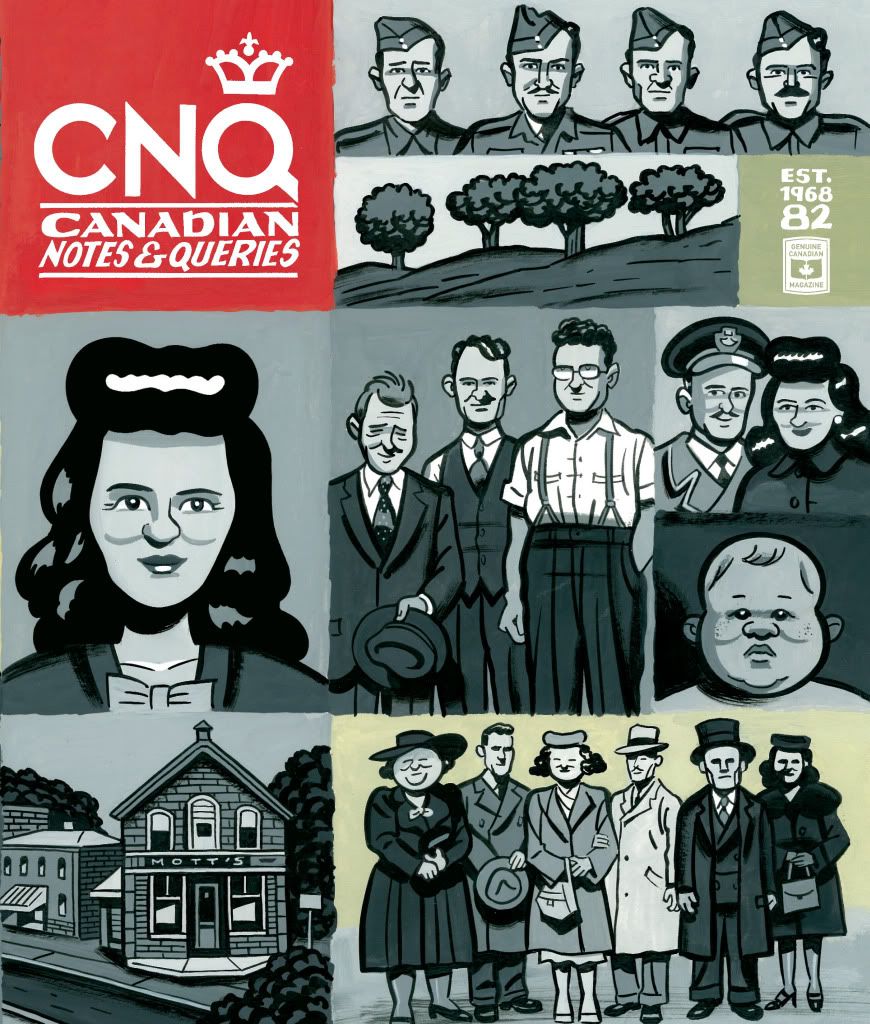
CNQ 82

My copy of CNQ 82 finally arrived last week. Hard to overpraise or even do justice to it. There isn’t a dull piece in the issue, from the Seth cover that goes bang in the eye to Marius Kociejowski's anecdote-brimming, name-dropping memoir about his life as a rare books dealer (his account of Annie Lennox walking into his shop is priceless). There are a clutch of dazzling poems by Laura Lush (full disclosure: I’m the CNQ poetry editor), as well as penetrating reviews by Nyla Matuk and Shane Neilson. There's also a shrewd, helpful piece by Nigel Beale on where to look for the penny-stocks of CanLit in order to build a book collection that might grow in value. Of course, It wouldn’t be CNQ if the magazine didn’t include some combat journalism, which this time comes courtesy of Darryl Whetter who provides a long annihilating essay on last year’s Giller shortlist and winner. Much of this material isn't available online yet (I hope that's remedied soon). But you can try to locate a copy in one of your better bookstores or contact the magazine directly. Or you could stop being such a cheap bastard and subscribe already.

Saturday, 24 September 2011

Signal Spotting

Two Signal poets make an appearance in the Fall issue of Maisonneuve, now on newsstands. Nyla Matuk has two superb poems from her upcoming book, Sumptuary Laws, due out from us in Spring 2012 (a clutch of new work will also appear in the forthcoming CNQ 82). Jason Guriel has a stiletto-sharp take-down of last year's Harbourfront Battle of the Bards. Both pieces are behind the paywall, so you'll need to buy a copy. Or better yet, subscribe.