Showing posts with label Shane Neilson. Show all posts

Sunday, 31 January 2016

Sunday Poem

ROAD ENDING 
At the end of the road a hunter’s hut
boarded all summer, the fraying bush
backing against it, a ragged fringe
of beggar’s ticks, rust tassels, thorns,
and boulders pushed to the water’s edge
where the graders turned.
There was no one home. 
And no one in the water. Overhead
the white threads spidered from a jet
drifted across where the evening star
was not yet shining. 
What were the words I could not use,
the thoughts I could not think to say?
The white lake shook in the early dusk. 
Something was lost we were waiting for,
summer, perhaps, or snow.
By M. Travis Lane, from The Essential M. Travis Lane 
(ed. Shane Neilson, The Porcupine's Quill, 2015)

Sunday, 14 December 2014

Sunday Poem

GIVEN

The secrets of losing recede until regret
is the only expression: instruct in error,

in the luck that flung you into wonder.
I've held you evenings in a briarpatch,
spitting lullabyes that permit a temporary claim.

Song of diamond, ease, mortal wound, the shared cry
that you were never mine as I am not yours. 
Fathers distinguish love's night terrors from dreams,
years on. Your own sons will long
for bedtime stories, and you too will spill
the secret I'm trying to tell: our feelings are am,

what will be. By day we play, are hurt within
protectorates of choice. I can't choose.
You were given to me. To lose.

From We Need Our Names (Anstruther Press, 2014) by Shane Neilson 

Monday, 13 October 2014

The Church Poet


Shane Neilson wonders if M. Travis Lane's reputation as a Christian poet has harmed appreciation of her work:
[B]y choosing to write about religious themes, Lane faces a problem that any poet would face: she is often ignored. As Eliot wrote, “For the great majority of people who love poetry, ‘religious poetry’ is a variety of minor poetry.” Yet Lane is special: a major poet who bucked the trend away from religion. She stubbornly took it on, along with any number of other subjects. Stubbornly, she wrote well on topics few are disposed to read. Lane’s natural gifts with image, sound, pacing, and argument took on the challenge of writing spirit as poetry. Despite these formidable gifts and the successfully met challenge, Lane’s not received her due.

Saturday, 8 October 2011

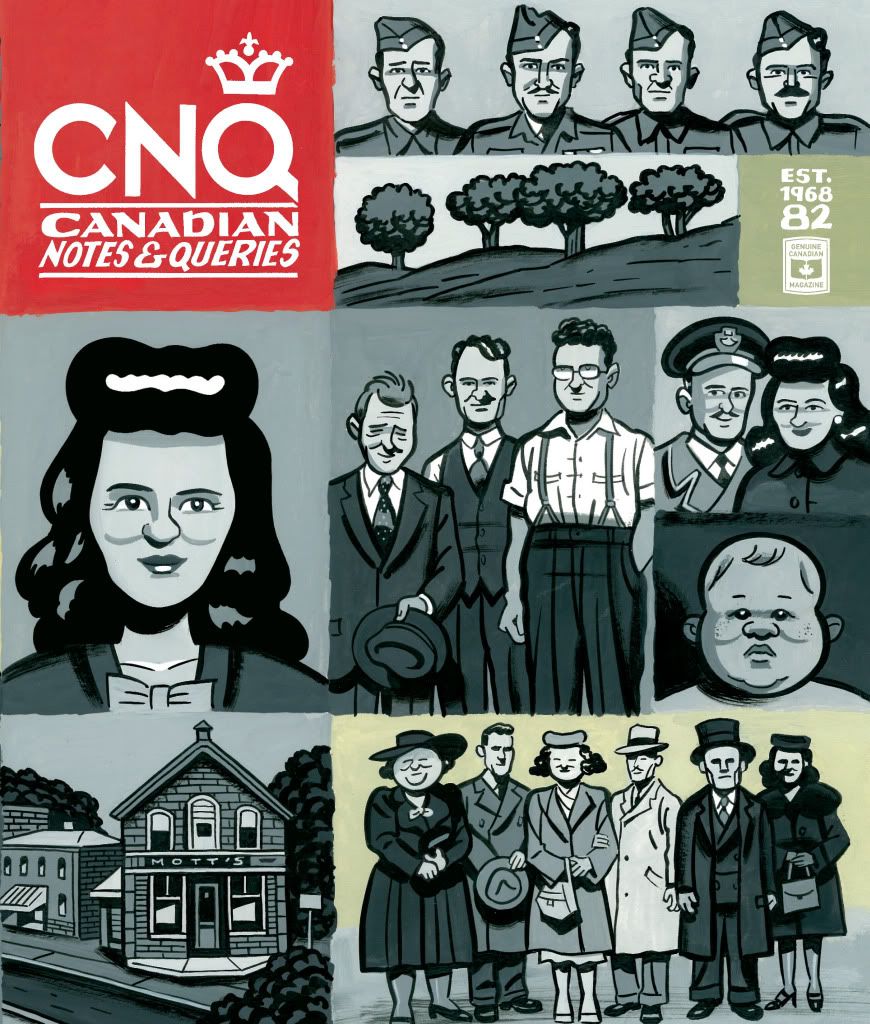
CNQ 82

My copy of CNQ 82 finally arrived last week. Hard to overpraise or even do justice to it. There isn’t a dull piece in the issue, from the Seth cover that goes bang in the eye to Marius Kociejowski's anecdote-brimming, name-dropping memoir about his life as a rare books dealer (his account of Annie Lennox walking into his shop is priceless). There are a clutch of dazzling poems by Laura Lush (full disclosure: I’m the CNQ poetry editor), as well as penetrating reviews by Nyla Matuk and Shane Neilson. There's also a shrewd, helpful piece by Nigel Beale on where to look for the penny-stocks of CanLit in order to build a book collection that might grow in value. Of course, It wouldn’t be CNQ if the magazine didn’t include some combat journalism, which this time comes courtesy of Darryl Whetter who provides a long annihilating essay on last year’s Giller shortlist and winner. Much of this material isn't available online yet (I hope that's remedied soon). But you can try to locate a copy in one of your better bookstores or contact the magazine directly. Or you could stop being such a cheap bastard and subscribe already.

Tuesday, 26 April 2011

Canadian Masters

I've got a beautiful new book. Here's what's in it: twenty of John Glassco's top poems plus a 5500-word introduction that was supposed to be an essay on Glassco but turned out to also be a inquiry into oblivion, junkyards, Montreal's decline as a poetry superpower, Paris in the 30s, dandyism as an extreme sport, TISH and why fiction is truer than traditional memoir. I am indebted to the Frog Hollow team of Shane Neilson and Caryl Peters for their superhuman patience as I took my sweet time finishing this commission (four years!). Milton was right on the money: They also serve who only stand and wait.

Thursday, 7 April 2011

Battle of the Bards

I know Shane Neilson's first piece on the event raised some hackles. Fair enough. But his follow up has some pretty funny moments.

Saturday, 9 October 2010

Recommendations


In anticipation of the GG shortlist announcement on Wednesday, I thought I'd take a moment to mention the Canadian poetry I enjoyed most this year.

Excluded is The Crow's Vow, a Signal book and therefore, according to industry etiquette, not eligible for objective recommendation. I would, however, like to make a plug (plea?) for Michael Harris's Circus which, except for a couple of notices, has been roundly ignored. And I think that's just criminal.

I suppose I should also disclose that I provided blurbs for two books on this list (Patternicity and Complete Physical). But I don't see why that should make any difference. I blurbed them precisely because I admired them.
For and Against (Goose Lane), Sharon McCartney.
Patternicity (Nightwood), Jim Johnstone.
Bloom (Anansi), Michael Lista
Welling (Your Scrivener Press), Margaret Christakos
Tiny, Frantic, Stronger (Insomniac), Jeff Latosik
Hump (Palimpsest), Ariel Gordon
Complete Physical (Porcupine's Quill), Shane Neilson

Thursday, 24 December 2009

What I liked in 2009


Friends have been busting my chops to make public my favourite Canadian poetry of 2009. Since I've always had a weakness for bad advice, I’ve gone ahead and nailed my colours to the mast (if you're impatient, skip down the end).

To be frank, this sort of best-of exercise always leaves me in some distress because I have to overlook the books I feel strongest about, namely the titles I shepherd into print for Vehicule press. In 2009, those would be: Pure Product by Jason Guriel, Animals of My Own Kind by Harry Thurston and Boxing the Compass by Richard Greene. Each of these poets, while plainly unpigeonholeable, exemplify in their practice the values I’ve been trying to “brand” at Signal Editions: poetry that has a premium on intellectual idiosyncrasy, is technically mettlesome, brandishes an exacting sense of diction (but also allows for moments when that diction takes leave of its senses), and is bullshit-free.

So those three books, heartbreakingly, aren't on my list. Also missing are a couple of formidable collections whose only sin is that I guest-edited them: Figuring Ground by Robert Moore (Wolsak & Wynne) and Trace and Track by Zach Wells (Biblioasis).

So what's left? A list rich in authentic, affecting, well-rounded, unposturing poetry. What drew me to these ten books, however, wasn't their Goldilocks proportionality (not too hot, not too cold, just right) but that they were working at full poetic boil. They were also -- except, of course, for Rogers -- arresting advances on the respective poet’s prior books (especially Klassen who emerged as a far more exciting poet than I remember). In fact, I feel like our entire poetry scene has, over the last decade, teleported itself into a new level of ambition, with poets now sniffing out property values at the top of Parnassus (a topic I touched on here). We are becoming what Charles Simic -- in his essay “The Trouble with Poetry” -- called “a carnival of styles,” or poetry “that has the feel of cable televison with more than three hundred channels.”

Enough palavering. Here are the ten books I think 2009 might be remembered by.

Jane Again (Biblioasis), Wayne Clifford
Lean-to (Gaspereau), Tonja Gunvaldsen Klassen
Meniscus (Bibloasis), Shane Neilson
True Concessions (Goose Lane), Craig Poile
Paper Radio (ECW), Damian Rogers
Pause for Breath (Biblioasis), Robyn Sarah
Pigeon (Anansi), Karen Solie
Seaway: New and Selected Poems (Salmon Publishing), Todd Swift
The Hayflick Limit (Coach House), Matthew Tierney
Mole (Anansi), Patrick Warner

Honourable mention: Oneiric (Frog Hollow Press), Nyla Matuk